Gyeongju
The Silla capital for a thousand years: royal tombs in town, Bulguksa and Seokguram, and sites open into the night
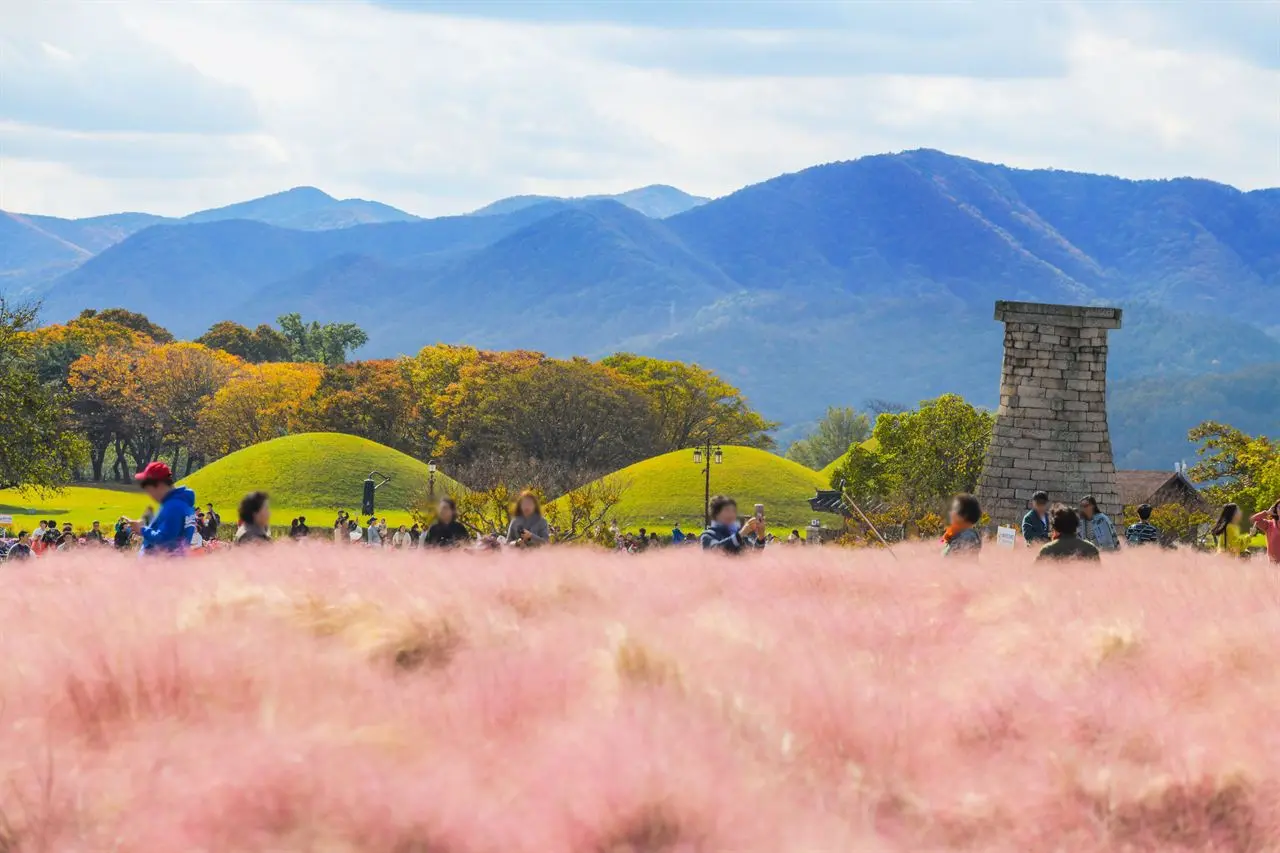
Gyeongju was the capital of the Silla kingdom for close to a thousand years, and much of what survives is in or near the modern town. This page helps you decide how long to stay, where to base yourself, what to eat and when to come, then sends you to our pages for the details.
Intro
Gyeongju was the capital of the Silla kingdom from 57 BC to AD 935. Three UNESCO World Heritage listings are here: Seokguram Grotto and Bulguksa Temple (1995), the Gyeongju Historic Areas (2000), which cover 52 designated heritage sites in five districts, and Yangdong Village.
Four reasons to go:
- Royal tombs in the middle of town. The grassy burial mounds of Daereungwon stand between streets and houses, and Cheomseongdae, the Wolseong palace site and Donggung Palace and Wolji Pond are within walking distance. The city’s own short-trip course keeps to a radius of about 3 km.
- Bulguksa and Seokguram. An 8th-century Silla temple and the stone grotto above it on Tohamsan, both free to enter.
- Historic sites at night. Daereungwon’s main gate, Woljeonggyo Bridge and Donggung Palace and Wolji Pond stay open until 22:00, and Cheomseongdae until 22:00 (21:00 from November to February).
- Hwangnidan-gil. A street of cafes, restaurants and small shops in old houses next to the tomb park, with Gyeongju snacks such as Hwangnam bread and burdock gimbap.
Areas
Central historic area
The tomb park, the observatory, the palace site, the museum and Hwangnidan-gil, all walkable. This is the area to base yourself for a short stay.
- Daereungwon and Hwangnidan-gil: The Silla tomb park with Cheonmachong, the one tomb open inside (3,000 won), plus Cheomseongdae, Gyerim Forest, Gyochon Village and Woljeonggyo Bridge, and the restaurants and snack shops of Hwangnidan-gil with prices.
- Donggung Palace and Wolji Pond: A Silla palace pond with lit pavilions, open until 22:00 (last entry 21:30), next to the free Gyeongju National Museum.
- Gyochon Hanok Village and Woljeonggyo Bridge: The Choi family house and Gyeongju Hyanggyo in a free hanok village, and Woljeonggyo Bridge, lit at night and open until 22:00, with village restaurants and the Woljeong circular buses.
Bulguksa and Tohamsan
- Bulguksa and Seokguram: The temple founded in 751 and the grotto Buddha above it, linked by an hourly bus or a forest trail of about an hour. City buses 10 and 11 take 35 to 45 minutes from the bus terminal, according to the city tourism site.
Bomun Lake Resort
About 10 km east of the center, a resort area of hotels, condominiums, golf courses and water sports around Bomun Lake, a man-made lake of about 1.65 square kilometers. The path around the lake is about 8 km, roughly 2 hours on foot, and the area is planted with many cherry trees. City buses 10 and 11 run here from town, and bus 710 from the KTX station. See Bomun Lake Resort for the lakeside path, Bomunjeong’s cherry blossoms, restaurants and bus 710 times.
Namsan
The Namsan district of the Gyeongju Historic Areas is a mountain scattered with Buddhas carved in rock and stone pagodas, such as the seated stone Buddha of Mireukgok, the three-story pagoda of Yongjangsagok and the rock-carved seated Buddha of Bulgok. See Gyeongju Namsan for the trails and their times, trail entry hours and bus 500.
Further out
- Yangdong Village: a Joseon-era village of the Son and Yi clans, north of the city in Gangdong-myeon, with 54 old houses over 200 years old; the whole village is a national folklore heritage site and, since 2010, a World Heritage Site. Admission is 4,000 won for adults; it is open 9:00 to 19:00 from April to September (tickets until 18:00) and 9:00 to 18:00 from October to March (tickets until 17:00). Visitors may not enter the houses without the owner’s permission. Bus 203 is the only bus into the village: it leaves the bus terminal about every one to two hours and takes about 35 minutes. Other buses in the 200s stop on the main road, about 1.2 km away. Worth it if you have two nights or more.
- Gyeongju’s East Coast: the underwater tomb of King Munmu, about 200 m off the shore at Bonggil-ri, the columnar joints at Yangnam, a natural monument since 2012, the twin pagodas of Gameunsa Temple Site and the fishing port of Gampo, with raw fish restaurants and bus times from town and the KTX station.
How many days
The city tourism site’s core course is for a day trip or a short one-night stay within about 3 km of the center, on foot or by bicycle: the national museum, Woljeonggyo, Cheomseongdae, Daereungwon and Donggung Palace and Wolji Pond on day one, then the Wolseong excavation site and Hwangnidan-gil on day two, adding Bulguksa or Bomun if you have time.
Our suggestion for one night, using the bus and opening times on our pages:
- Day one: arrive by KTX and take bus 50, 51 or 70 to Hwangnidan-gil for lunch. Walk through Daereungwon and Cheonmachong, Cheomseongdae, Gyerim Forest and Gyochon Village. Reach Gyeongju National Museum before it closes at 18:00, then see Donggung Palace and Wolji Pond after dark (last entry 21:30). Stay near Hwangnidan-gil.
- Day two: take bus 10 or 11 to Bulguksa, then bus 12 up to Seokguram. In the afternoon, go on to Bomun Lake, or head back to the KTX station. The last KTX to Seoul Station leaves Gyeongju at 22:38 and arrives at 0:42.
With two nights or more, add Namsan, Yangdong Village or the east coast.
For two days out of town by city bus in the order Korean travelers take them, the east coast from the Yangnam columnar joints to Gameunsa and Oksan Seowon to Yangdong Village, see Gyeongju Day Courses.
For a different 2-day plan with times, buses between stops, Bulguksa’s last entry and trains back to Seoul, see Gyeongju in 2 Days: A 1-Night Itinerary.
Day trips
- From Busan: easy. KTX trains run about 50 times a day from Busan Station and take 28 to 36 minutes (10,100 won standard class); the first leaves at 5:19 and the last back to Busan leaves Gyeongju at 23:46 and arrives at 0:13. The KTX-Eum from Bujeon takes 66 to 78 minutes (12,500 won).
- From Daegu: the KTX from Dongdaegu takes 18 to 20 minutes (7,500 won standard class). See Daegu and How to Get from Seoul to Daegu.
- From Seoul: possible but long. The first KTX leaves Seoul Station at 5:13 and takes about 2 hours 15 minutes, and the last train back leaves Gyeongju at 22:38, arriving at Seoul Station at 0:42. A round trip in standard class costs 89,000 won, and the city bus between the KTX station and the center adds 20 to 30 minutes each way. We recommend staying at least one night.
Times, fares and the buses from the station are in How to Get from Seoul to Gyeongju.
Where to stay
- Hwangnidan-gil and Daereungwon: within walking distance of the express and intercity bus terminals, the central sights and most restaurants, and the sights that open late. There are hanok stays in the area. This is the best base for a short stay.
- Bomun Lake Resort: lakeside hotels and resorts; the bus 710 stops are named after hotels such as Hilton, Lahan Select, Sono Calm, Commodore and Kensington. Bus 710 runs 12 times a day from the KTX station, and buses 10 and 11 run from town. You need a bus or taxi to reach the sights.
- Near Bulguksa: convenient for seeing the temple early in the morning, with a bus ride into town in the evening.
- Near the KTX station: we do not recommend it, as the station is outside the city, far from the sights.
What to eat
- Ssambap: rice with plates of leaves for wrapping, served at restaurants around Daereungwon, such as pork ssambap for 18,000 won per person at Jeongnok Ssambap.
- Mulhoe: cold soups with raw beef, such as Gyeongju yukhoe mulhoe (15,900 won at Hyanghwajeong) and hanwoo mulhoe (17,000 won at Hamyangjip).
- Snacks: Hwangnam bread, a red bean pastry (1,400 won each), 10-won bread with cheese (about 3,000 to 3,500 won), and burdock gimbap.
Restaurant names, menus and hours are in Daereungwon and Hwangnidan-gil. For 33 restaurants and bakeries across the city by area, see Where Gyeongju Locals Eat, and for coffee, Gyeongju Cafes Locals Love.
When to go
Cherry blossoms. Gyeongju has cherry trees across the city. In 2026 the city posted cherry blossom updates from late March to April 22, and on April 7 it announced full bloom at Bomun, Cheomseongdae, the eastern historic area, Hwangnidan-gil and the stone wall road by Daereungwon. The Gyeongju Cherry Blossom Marathon, with about 15,000 runners around Bomun and downtown, was held on April 4, 2026, and the Daereungwon stone wall road was closed to cars for a festival on April 3 to 5. Expect road closures on marathon day. The 2027 dates have not been announced; follow the city’s cherry blossom updates from late March.
Autumn. Recent visitors’ posts show pink grass and flower fields around Cheomseongdae in autumn, and autumn leaves at Bulguksa and yellow ginkgo at Tongiljeon in early to mid-November, with crowds at Bulguksa on weekends.
Weather: for average temperatures, rain and what to wear each month, see Korea Weather by Month and When to Go.
Getting there and around
- From Seoul and Busan: KTX trains stop at Gyeongju Station (formerly Singyeongju), outside the city; express and intercity buses stop at terminals in town. See How to Get from Seoul to Gyeongju.
- Booking trains: How to Take the KTX in Korea.
- Paying for buses: a T-money card works on Gyeongju’s city buses. See Paying with Foreign Cards in Korea.
- Maps: Map apps in Korea.
- Luggage: Gyeongju Station has lockers and a luggage delivery counter; see the station card in How to Get from Seoul to Gyeongju.
- To and from Pohang: intercity buses run between the two cities’ downtown terminals, about 35 to 45 minutes; 4,600 won from Pohang to Gyeongju (regular bus).
If you are also visiting the capital, see Seoul.
Questions travelers ask
Is Gyeongju worth visiting?
Gyeongju suits travelers interested in history: it was the Silla capital from 57 BC to AD 935 and has three UNESCO World Heritage listings, with royal tombs in the middle of town and Bulguksa and Seokguram on Tohamsan. Daereungwon’s main gate, Woljeonggyo Bridge and Donggung Palace and Wolji Pond stay open until 22:00, which is one reason to stay the night.
Gyeongju or Jeonju?
Choose Gyeongju for Silla tombs, temples and ruins; it is 28 to 36 minutes from Busan by KTX, so it fits a trip that includes Busan. Choose Jeonju for a hanok village of about 700 houses and its food; it is closer to Seoul, about 1 hour 45 minutes by KTX from Yongsan. We suggest one night in either.
Can I visit Gyeongju as a day trip from Seoul?
It is possible but long. The first KTX leaves Seoul Station at 5:13 and takes about 2 hours 15 minutes, the last train back leaves Gyeongju at 22:38 and arrives at 0:42, and a round trip costs 89,000 won in standard class, plus 20 to 30 minutes each way on the city bus from the station. We recommend at least one night; see Gyeongju in 2 Days: A 1-Night Itinerary.
Hotels
Experiences
Sources
- Korea Tourism Organization (VisitKorea): Gyeongju Historic Areas, Yangdong Village, Bomun Tourist Complex, Bomun Lake, Gyeongju Namsan, Tomb of King Munmu, Yangnam columnar joints and hanok stay entries (Korean; search by name) (accessed 2026-11-11)
- Korea Heritage Service: Seokguram Grotto, World Heritage listing (Korean) (accessed 2026-11-11)
- Gyeongju City tourism site: core city-center course for a day or one night (Korean) (accessed 2026-11-11)
- Gyeongju City tourism site: cherry blossom updates, 2026 (Korean) (accessed 2026-11-11)
- Gyeongju City tourism site: touring Gyeongju by bus 10 (Korean) (accessed 2026-11-11)
- Segye Ilbo: cherry blossoms in full bloom across Gyeongju (April 7, 2026) (Korean) (accessed 2026-11-11)
- Yangdong Village: opening hours and admission (Korean) (accessed 2026-11-11)
- Saecheonnyeon Miso (Gyeongju city bus operator): route search for Yangdong (Korean) (accessed 2026-11-11)
- Saecheonnyeon Miso: bus 203 stops and timetable (Korean) (accessed 2026-11-13)
- Yangdong Village: UNESCO World Heritage listing, July 31, 2010 (Korean) (accessed 2026-11-13)
- Yangdong Village: directions (Korean) (accessed 2026-11-13)
- Saecheonnyeon Miso: route search for Gyeongju Station (bus 710 stops at Bomun hotels) (Korean) (accessed 2026-11-11)
- Korail: KTX timetable and fares (accessed 2026-11-11)
- Naver blog: autumn ginkgo at Tongiljeon and crowds at Bulguksa (2026-11-11) (accessed 2026-11-11)