Day Trips from Busan: Tongdosa Temple and Gimhae
A UNESCO temple with no Buddha statue, 25 minutes by bus from Nopo, and Gaya tombs and museums by light rail
Intro
Two day trips from Busan by subway and one more ride. Tongdosa is one of the great Buddhist temples of Korea, in Yangsan just north of Busan, reached by a 25-minute intercity bus from Nopo and a walk along a pine path. Gimhae, west of Busan on the Busan-Gimhae Light Rail, was the center of the Gaya kingdoms: you can walk between royal burial mounds listed by UNESCO, two free museums and the tomb of the legendary King Suro, with lunch in the restaurant lanes of Bonghwang-dong.
Both work without a car, and both are best avoided on Mondays, when the museums close.
Tongdosa or Gimhae?
- Tongdosa if you want one big working temple in the hills: a walk through old pines, a main hall with no Buddha statue, and the chance to stay the night. It is free and open every day. Busan’s own big mountain temple is Beomeosa, on Line 1; Tongdosa is a World Heritage Site and a bus ride further.
- Gimhae if you are interested in early Korean history: the Gaya states, their iron, and the burial mounds of their kings, all free and within walking distance of the light rail.
Tongdosa Temple and the pine path
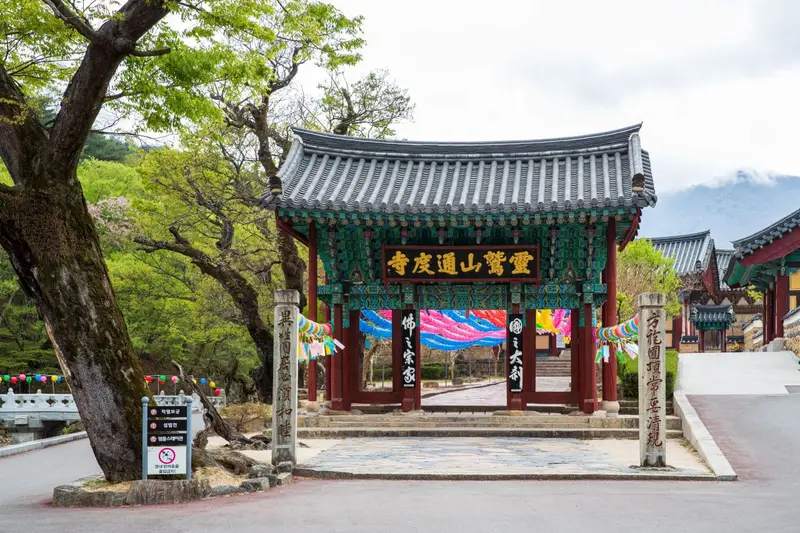
Tongdosa was founded in 646 by the monk Jajang, who, the temple says, brought relics of the Buddha and part of his robe back from China and enshrined them here. That makes it the Buddha temple among Korea’s three “jewel” temples. The relics are kept at the Diamond Precept Platform (Geumgang Gyedan), next to the main hall, where monks are ordained, and so the main hall (Daeungjeon) has no statue: worshippers face the platform instead. The temple’s English website counts more than 50 buildings in the grounds. In 2018 Tongdosa was one of the seven mountain monasteries, founded between the 7th and 9th centuries and still active, that UNESCO added to the World Heritage List together as Korea’s 13th World Heritage Site, by the Korea Heritage Service’s announcement.
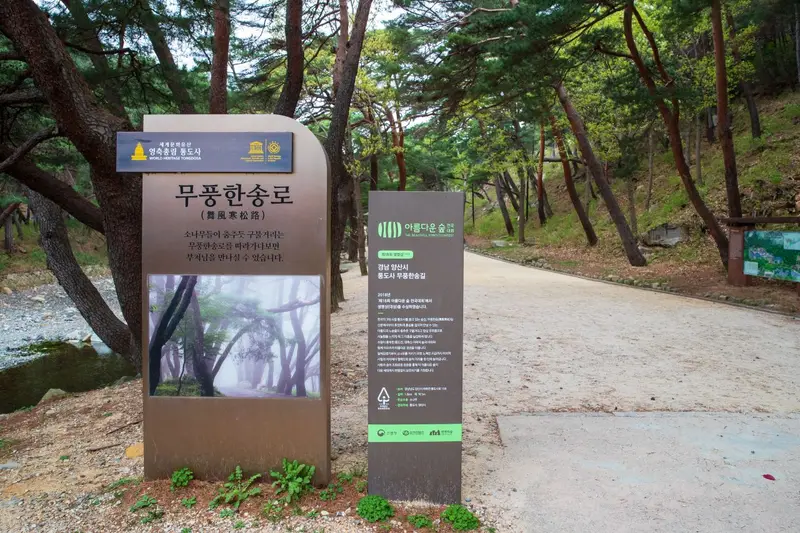
The way in is part of the visit. From the temple’s outer gate, an earth path of about 1.2 km, the Mupung Hansong-ro, runs beside a stream under old pines to the One Pillar Gate. Yangsan City finished work on the path in 2024; it won the top prize at Korea’s Beautiful Forest awards in 2018.
The grounds are open from 8:30 to 17:30, and admission has been free since May 2023. The inner area of the Diamond Precept Platform is opened only on set days of the lunar calendar, from 11:00 to 14:00, and not when the ground is wet; the dates are on the place card. The Seongbo Museum, the temple’s museum of Buddhist heritage, reopened in October 2026 after a year of work; until December 4, 2026, it charges 3,000 won during a special exhibition of Thai Buddhist art.
One Korean visitor in a November 2026 blog post allows about an hour to an hour and a half to walk the pine path and see the main sights, there and back. Visitors also report eating lunch (bibimbap and soup) in the temple’s dining hall, with serving starting anywhere from before 11:00 to around noon and ending when the food runs out, and rinsing their own bowls afterwards. This is not in the temple’s visitor information, so do not count on it. Otherwise, eat in the restaurant row by the outer gate.
Temple stay at Tongdosa
The national Templestay website lists Tongdosa as a temple for foreigners. Its English page offers a relaxation stay, Just Relaxation, A Brief Journey of Practice: one night from Monday to Friday, 100,000 won for adults and teenagers, listed until February 2027. You get a room and meals and are free the rest of the time; the temple tour, the evening service and the 4:20 morning service are optional. Book on the English Templestay website at least 3 days ahead; the site recommends paying by credit card in the online booking on a computer. A set experience program also runs once or twice a month.
Getting to Tongdosa
Take Line 1 to its northern end, Nopo Station, next to Busan Central Bus Terminal. Buses to Tongdosa (Sinpyeong) (통도사(신평)) leave 24 times a day from 6:20 to 21:30 and take about 25 to 30 minutes on the Gyeongbu Expressway. The buses continue to Eonyang, so get off at Sinpyeong. The fare is 3,000 won for adults.
Seats are not reserved and tickets cannot be bought online. Korean visitors in 2026 blog posts bought tickets at the terminal from the intercity bus counters or machines (the express bus machines do not list Tongdosa), and several report boarding with a transit card instead. Buses can fill up: on autumn weekends and even weekday mornings, visitors report full buses and waiting for the next one, so get in the queue early.
| Nopo to Sinpyeong | Sinpyeong to Nopo |
|---|---|
| 6:20, 6:50, 7:10, 7:40, 8:20, 9:00, 9:35, 10:10, 10:50, 11:30, 12:10, 12:50 | 6:35, 7:05, 7:24, 7:55, 8:25, 9:15, 9:50, 10:25, 11:05, 11:45, 12:25, 13:05 |
| 13:40, 14:20, 15:00, 15:40, 16:20, 17:05, 17:45, 18:20, 18:55, 19:45, 20:40, 21:30 | 13:55, 14:35, 15:15, 15:55, 16:35, 17:20, 18:00, 18:35, 19:10, 20:00, 20:55, 21:45 |
Times from the timetable posted by the temple on February 24, 2026 (Purun Transport, 051-508-0917). The Nopo departures matched the T-money booking site for November 2026.
From the Sinpyeong terminal (통도사신평버스터미널) it is a short walk to the temple’s outer gate, then the pine path. Korean visitors in 2026 blog posts took about 30 to 40 minutes on foot from the terminal to the main temple. The temple’s hermitages and the buckwheat fields higher up the valley are a long walk further: one 2026 blog post gives 3.4 km (about 55 minutes on foot) from the terminal to the buckwheat fields, and its writer took a taxi there.
From Seoul by KTX. The nearest KTX station is Ulsan (Tongdosa) Station. The temple’s directions give city bus 13 to Sinpyeong, about 30 minutes, or a taxi, about 25 minutes. For the KTX itself, see How to Get from Seoul to Busan.
Gimhae and the Gaya kingdoms
Gaya was a group of small states in the south of the Korean peninsula from the 1st to the 6th century, known for iron; Geumgwan Gaya was the one centered on Gimhae. Seven Gaya burial mound clusters in seven towns were added to the UNESCO World Heritage List together in 2023, and Gimhae’s Daeseong-dong is one of them. The museums and the tomb are free and within 15 minutes’ walk of a light rail station.
- Gimhae National Museum (Bakmulgwan Station): the place to start, with the whole story of Gaya from the objects found in its tombs. Volunteer gallery talks run most days at 11:00 or 14:00, in a language the museum does not state.
- Daeseong-dong Tumuli and Museum (Bakmulgwan Station): the burial ground of Geumgwan Gaya’s rulers, with two excavated tombs shown as they were found.
- Royal Tomb of King Suro (Surowangneung Station): the tomb of Gaya’s legendary founder, open every day, including Mondays.
- Gimhae Gaya Theme Park: a reconstructed palace and rides on a hill above the town, for families. Free shuttle from Injedae Station, Wednesday to Sunday.
The two museums close on Mondays, and the theme park and its shuttle too, so go from Tuesday to Sunday (Wednesday to Sunday if you want the shuttle). In November to February, the Royal Tomb closes at 18:00 and the museums take last entry at 17:30.
Where to eat
Bongridan-gil is the name for the restaurant and cafe lanes of Bonghwang-dong, 11 minutes on foot from Exit 3 of Bonghwang Station. Ohiruten, on its main street, serves tendon (tempura rice bowls) from 11,900 won and has a remote waiting list on the Tabling app. If you stay into the evening, try dwitgogi, Gimhae’s grilled pork from mixed small cuts, in the restaurants of Bonghwang-dong and Buwon-dong.
At Tongdosa, Gyeonggi Sikdang, open since 1975, serves sanchae bibimbap (mountain greens) for 9,000 won by its Naver menu. It closes on Mondays.
Getting to Gimhae
Take Line 2 to Sasang (or Line 3 to Daejeo) and change to the Busan-Gimhae Light Rail toward Gaya University (가야대). Trains leave Sasang from 5:00; the first one reaches Surowangneung at 5:31. Get off at:
- Bonghwang (Exit 3) for Bongridan-gil and lunch.
- Surowangneung (Exit 2) for the Royal Tomb of King Suro, 13 minutes on foot.
- Bakmulgwan (Museum) (Exit 2) for the Daeseong-dong Tumuli Museum (7 minutes) and Gimhae National Museum (8 minutes).
- Injedae (Exit 1) for the Gaya Theme Park shuttle.
From Sasang to these stations is the light rail’s zone 2 fare: 1,800 won with a transit card or 1,900 won with a single ticket. If you change from the Busan subway or a Busan bus within 30 minutes with a transit card such as T-money, the change is free and you pay only the higher of the fares. See Paying with Foreign Cards in Korea for transit cards.
Common questions
- How do I get from Busan to Tongdosa Temple? Line 1 to Nopo, then the intercity bus from Busan Central Bus Terminal to Tongdosa (Sinpyeong), 24 a day, about 25 to 30 minutes, 3,000 won. Walk from the terminal to the temple.
- What time is the last bus back from Tongdosa? 21:45 from Sinpyeong to Nopo, by the timetable the temple posted in February 2026.
- Is Tongdosa free? Yes, since May 2023. The grounds are open from 8:30 to 17:30 every day.
- Is Tongdosa a UNESCO World Heritage Site? Yes. It is one of seven Korean Buddhist mountain monasteries listed together in 2018.
- Can foreigners do a temple stay at Tongdosa? Yes. The Templestay website lists it as a temple for foreigners, with an English page for a relaxation stay from Monday to Friday, 100,000 won a night. Book at least 3 days ahead.
- Why is there no Buddha statue in Tongdosa’s main hall? Because the temple keeps relics of the Buddha at the Diamond Precept Platform beside the hall, and worshippers face the platform instead.
- What is there to do in Gimhae? The Gaya burial mounds at Daeseong-dong, Gimhae National Museum, the Royal Tomb of King Suro and, with children, Gimhae Gaya Theme Park, all on or near the Busan-Gimhae Light Rail.
- Are Gimhae’s museums open on Mondays? No. The Daeseong-dong Tumuli Museum and Gimhae National Museum close on Mondays; the Royal Tomb of King Suro is open.
- How much is the Busan-Gimhae Light Rail? From Sasang to the stations for the tombs and museums, 1,800 won with a transit card.
Practical information
- Mondays: avoid them for Gimhae, and for the Tongdosa museum and Gyeonggi Sikdang.
- Weekends: the Tongdosa bus from Nopo fills up on weekend mornings in autumn, visitors report; go early.
- Booking: nothing on this page needs a booking except the temple stay, the Tongdosa guided tours (groups of 5 or more) and the children’s museum in Gimhae.
- Where to stay: these are day trips from Busan; see Where to stay in Busan. The temple stay is the only overnight option on this page.
- Nearby: Beomeosa Temple and Geumjeongsan, also on Line 1. Back to the Busan guide.
Get There
-
Nopo StationBusan Metro Line 1
- Korean
- 노포역
- Exit
- unconfirmed
- Walk
- unconfirmed
For Tongdosa. The northern end of Line 1, next to Busan Central Bus Terminal (부산종합버스터미널), where the intercity buses to Tongdosa (Sinpyeong) leave.
-
Sasang StationBusan Metro Line 2, Busan-Gimhae Light Rail
- Korean
- 사상역
- Exit
- unconfirmed
- Walk
- unconfirmed
For Gimhae. Change from Line 2 to the light rail toward Gaya University (가야대). From Line 3, change at Daejeo Station (대저역) instead.
-
Surowangneung StationBusan-Gimhae Light Rail
- Korean
- 수로왕릉역
- Exit
- Exit 2
- Walk
- 13 min
For the Royal Tomb of King Suro, 770 m from Exit 2.
-
Bakmulgwan (Museum) StationBusan-Gimhae Light Rail
- Korean
- 박물관역
- Exit
- Exit 2
- Walk
- 7 min
For the Daeseong-dong Tumuli Museum (440 m, about 7 minutes) and Gimhae National Museum (498 m, about 8 minutes).
-
Bonghwang StationBusan-Gimhae Light Rail
- Korean
- 봉황역
- Exit
- Exit 3
- Walk
- 9 min
For Ohiruten (516 m, about 9 minutes from Exit 3) and Bongridan-gil (629 m, about 11 minutes).
-
Injedae (Inje University) StationBusan-Gimhae Light Rail
- Korean
- 인제대역
- Exit
- Exit 1
- Walk
- unconfirmed
For the free shuttle bus to Gimhae Gaya Theme Park (Wednesday to Sunday).
Hours & Fees
- Bus to Tongdosa
- Intercity bus from Busan Central Bus Terminal at Nopo to Tongdosa (Sinpyeong), 24 a day from 6:20 to 21:30, about 25 to 30 minutes. Adults 3,000 won, middle and high school students 2,400 won, children 1,500 won. Unreserved seats, no online booking
- Bus back to Busan
- From Tongdosa (Sinpyeong) to Nopo, 24 a day from 6:35 to 21:45 (timetable posted by the temple, February 24, 2026)
- Light rail to Gimhae
- Sasang to Surowangneung, Bakmulgwan (Museum) or Bonghwang station: 1,800 won with a transit card, 1,900 won with a single ticket. Changing to or from the Busan subway or buses within 30 minutes is free; you pay the higher of the fares
- Mondays
- Closed: Daeseong-dong Tumuli Museum and Gimhae National Museum (the first weekday after instead, when Monday is a public holiday), Gimhae Gaya Theme Park (open when Monday is a public holiday), Tongdosa Seongbo Museum and Gyeonggi Sikdang. Tongdosa's grounds and the Royal Tomb of King Suro are open
Places by area
Tongdosa (Yangsan)
-
Tongdosa Temple
The Buddha temple among Korea's three "jewel" temples, in Yangsan just north of Busan. The temple says the monk Jajang brought relics of the Buddha, among them part of his robe, from China and enshrined them here in 646. Because the relics are kept at the Diamond Precept Platform (Geumgang Gyedan) beside the main hall, the main hall has no Buddha statue: people pray toward the platform instead. Tongdosa is one of the seven Buddhist mountain monasteries that UNESCO added to the World Heritage List together in 2018. It is entered along a pine path of about 1.2 km; see Tongdosa Temple and the pine path.
- Hours
- 8:30 to 17:30 every day. Visitors joining the dawn service may enter from 4:00
- Admission
- Free since May 4, 2023
- Diamond Precept Platform
- The inner area is opened on set days of the lunar calendar (the 1st to 3rd, 15th, 18th and 24th of each lunar month), 11:00 to 14:00. It stays closed in rain or when the ground is wet
- Seongbo Museum
- The temple's museum reopened on October 3, 2026. Admission is charged for a limited period, October 3 to December 4, 2026, during a special exhibition: 3,000 won for adults (19 and over), 2,000 won for ages 8 to 18, free for preschool children and people 65 and over. Hours 9:30 to 17:00 in summer and 9:30 to 16:30 in winter (last entry 30 minutes before), closed on Mondays, January 1 and on the days of Seollal and Chuseok (Korea Tourism Organization). 055-382-1001 (Korean)
- Guided tours
- Free, by booking: groups of 5 or more, 3 days ahead; tours in English, Japanese or Chinese 7 days ahead. 10:00 to 16:00. plan@tongdosa.or.kr, 070-7700-3580
- Phone
- 055-382-7182 (Korean)
Foreigner access
- Korean name
- 통도사
- Booking
- None needed to visit
- English
- Signs: unconfirmed · Staff: Partly
The temple has an English website, and guided tours in English for groups of 5 or more can be booked 7 days ahead.
-
Tongdosa Temple Stay
An overnight stay at Tongdosa, which the national Templestay website marks as a temple for foreigners. Its English page lists a relaxation program, Just Relaxation, A Brief Journey of Practice, from Monday to Friday, one night: you get a room (bedding only) and meals in the dining hall, and the rest of the time is yours, with an optional temple tour, the evening service and the morning service at 4:20. Arrive between 13:30 and 14:00; check out at 9:30 to 10:00 the next morning.
- Just Relaxation
- 100,000 won per night for adults and teenagers. Monday to Friday, listed from August 1, 2025 to February 28, 2027
- Booking
- On the English Templestay website (templestay.com), until 3 days before the start date. The website recommends paying by credit card in the online booking on a computer
- Experience program
- A set program once or twice a month, with dates announced a month ahead. Men and women sleep in separate shared rooms
- Refunds
- 100% up to 5 days before, 70% 3 to 4 days before, 50% 1 to 2 days before, none on the day
- Contact
- +82-55-384-7111 (9:00 to 17:00), templestay@tongdosa.or.kr
Foreigner access
- Korean name
- 통도사 템플스테이
- Booking
- Book on the English Templestay website (templestay.com)
Korean phone number needed: unconfirmed - English
- Signs: unconfirmed · Staff: Partly
Listed as a temple for foreigners on the Templestay website, with an English program page.
-
Gyeonggi Sikdang
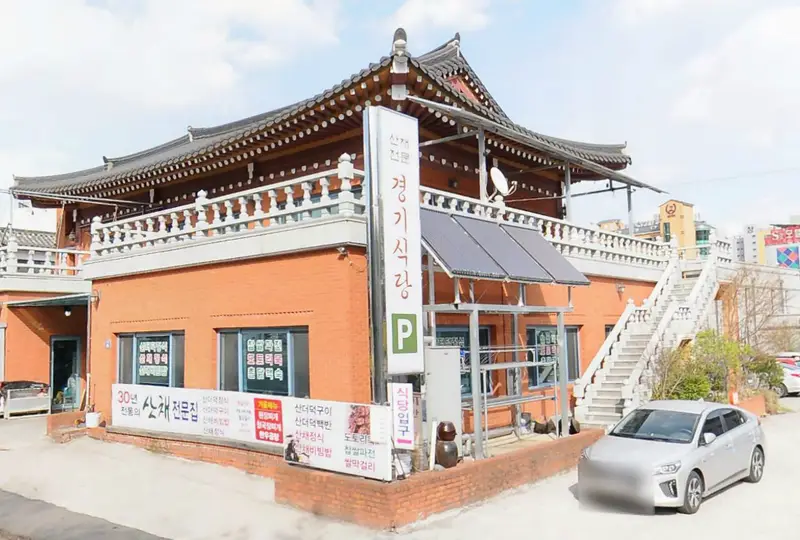
A restaurant for sanchae (wild mountain greens), in the row of restaurants by the temple's outer gate. By the restaurant's own account, it opened in 1975 by Seungseon Bridge, near the temple, moved to the present shopping block in 1982 and has served mountain-greens set meals and bibimbap from the start. Order the sanchae bibimbap or the sanchae jeongsik (set meal).
- Hours
- 9:00 to 19:00 (last order 18:20), Tuesday to Sunday. Closed on Mondays
- Prices
- Sanchae bibimbap 9,000 won and sanchae jeongsik 9,000 won on the restaurant's Naver menu, deodeok (grilled mountain root) set meal 13,000 won, glutinous rice pajeon 10,000 won, grilled deodeok 16,000 won, baeksuk (boiled chicken) 40,000 won
Foreigner access
- Korean name
- 경기식당
- Booking
- Walk-in
- English
- Menu: unconfirmed · Signs: unconfirmed · Staff: unconfirmed
- Queue app
- none
Gimhae
-
Daeseong-dong Tumuli and Museum
The burial ground of the ruling class of Geumgwan Gaya, the Gaya state centered on Gimhae. Daeseong-dong is one of seven Gaya burial mound clusters that UNESCO added to the World Heritage List together in 2023. The museum, opened in 2003, has a main exhibition hall and an outdoor exhibition hall where two wooden-chamber tombs, No. 29 and No. 39, are shown as they were excavated; the Korea Tourism Organization calls No. 29 the first royal tomb of the site.
- Hours
- 9:00 to 18:00, last entry 17:30
- Closed
- Mondays (when Monday is a public holiday, the first weekday after it), January 1 and the days of Seollal and Chuseok
- Admission
- Free
- Phone
- 055-350-0401 (Korean)
Foreigner access
- Korean name
- 대성동고분박물관
- Booking
- None needed
- English
- Signs: unconfirmed · Staff: unconfirmed
-
Gimhae National Museum
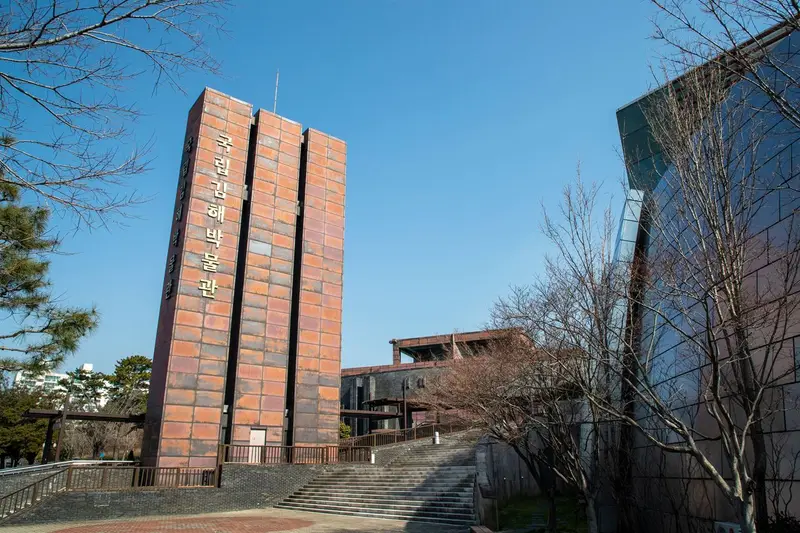
The national archaeology museum for the Gaya kingdoms, opened on July 29, 1998, at the foot of Gujibong, the hill tied to Gaya's founding legend. Its walls are faced with black brick to suggest iron ore and charcoal, for Gaya as a kingdom of iron. Almost everything on show was excavated from Gaya sites. The permanent exhibition was rebuilt over three years and reopened as World Heritage Gaya on January 22, 2024.
- Hours
- Permanent exhibition 9:00 to 18:00, last entry 30 minutes before closing
- Closed
- Mondays (when Monday is a public holiday, the first weekday after it), January 1, Seollal and Chuseok
- Admission
- Free. Special exhibitions may charge
- Guided tours
- Volunteer gallery talks on Tuesday at 11:00 and 14:00, Wednesday 11:00, Thursday 11:00 and 14:00, Friday 14:00, Saturday 11:00 and 14:00, Sunday 11:00 (subject to change). The language is not stated
- Children's museum
- 10:00 to 17:50 (closed 12:00 to 13:00). Book on the museum website by the day before; places left are given out on the day
- Phone
- 055-320-6800 (Korean)
Foreigner access
- Korean name
- 국립김해박물관
- Booking
- None needed for the exhibitions
- English
- Signs: unconfirmed · Staff: unconfirmed
-
Royal Tomb of King Suro
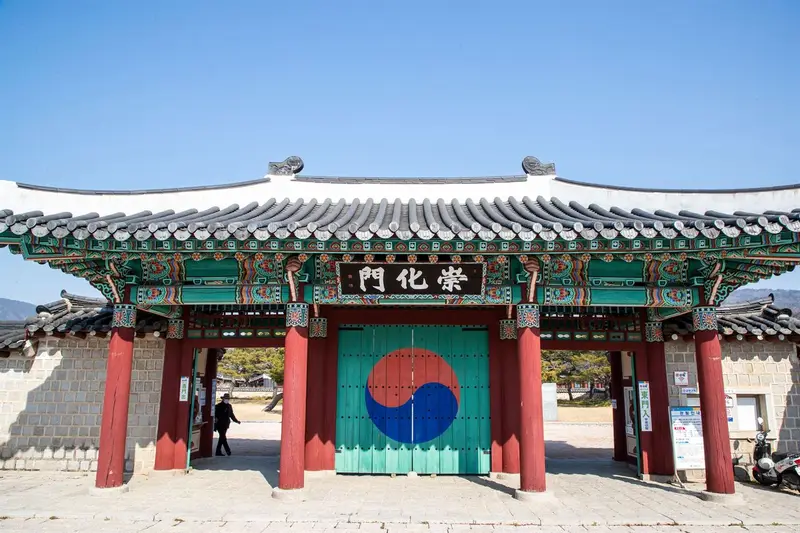
The tomb of King Suro, legendary founder of the Gaya state of Garak (Geumgwan Gaya) and of the Gimhae Kim clan, a round earth mound about 5 m high. By the traditional account, Suro took the throne in 42 AD and in 48 married Heo Hwang-ok, a princess from Ayuta in India. The tomb was given its present form in 1580; the stone in front of it dates from 1647, and the shrine hall Sungseonjeon, where the spirit tablets of the king and queen are kept, was named in 1884.
- Hours
- November to February 9:00 to 18:00; March and October 8:00 to 19:00; April to September 8:00 to 20:00. Open every day
- Admission
- Free. Wheelchairs and strollers can be borrowed free
- Phone
- 055-332-1094 (Korean)
Foreigner access
- Korean name
- 김해수로왕릉
Foreigner access details not yet confirmed
-
Gimhae Gaya Theme Park
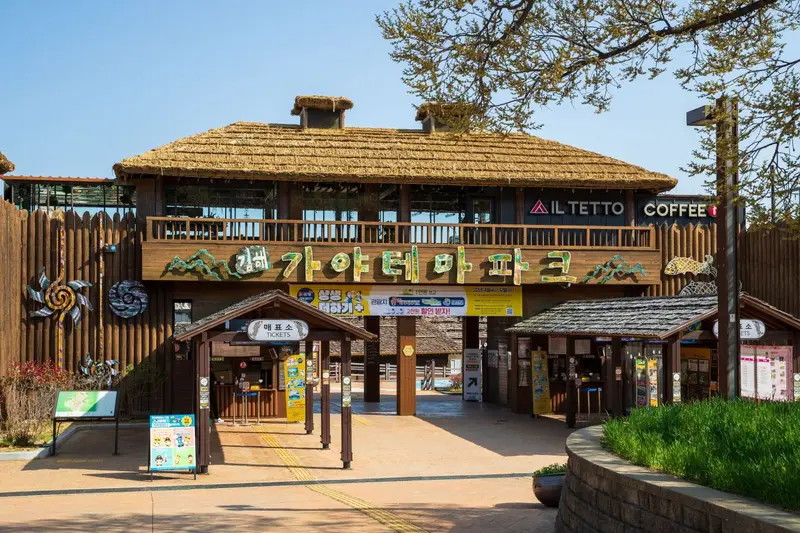
A theme park on a hill above Gimhae with a reconstructed Gaya royal palace, an exhibition hall, hands-on workshops and adventure rides. Worth it mainly with children. It is not reached on foot from the light rail: take the park's free shuttle from Injedae Station or a taxi.
- Hours
- 9:30 to 18:00, tickets sold until 17:00. Closed on Mondays (open when Monday is a public holiday)
- Admission
- Adults 7,000 won, teenagers 6,000 won, children and seniors 5,000 won. Rides, workshops and the show cost extra (packages from 9,000 won). The park says these are prices for domestic visitors and that overseas group rates differ
- Free shuttle
- For park visitors, from Exit 1 of Injedae Station. Wednesday to Friday at 10:20, 11:20, 13:20, 15:20 and 16:20; weekends and public holidays at 10:20, 11:20, 13:20, 14:20, 15:20, 16:20 and 17:20; it reaches the park 25 minutes later. No shuttle on Mondays and Tuesdays (it runs when they are public holidays)
- Phone
- 055-340-7900 (Korean)
Foreigner access
- Korean name
- 김해가야테마파크
- Booking
- Buy tickets at the park. Naver Booking also sells them
Korean phone number needed: No - English
- Signs: unconfirmed · Staff: unconfirmed
-
Ohiruten (main branch)
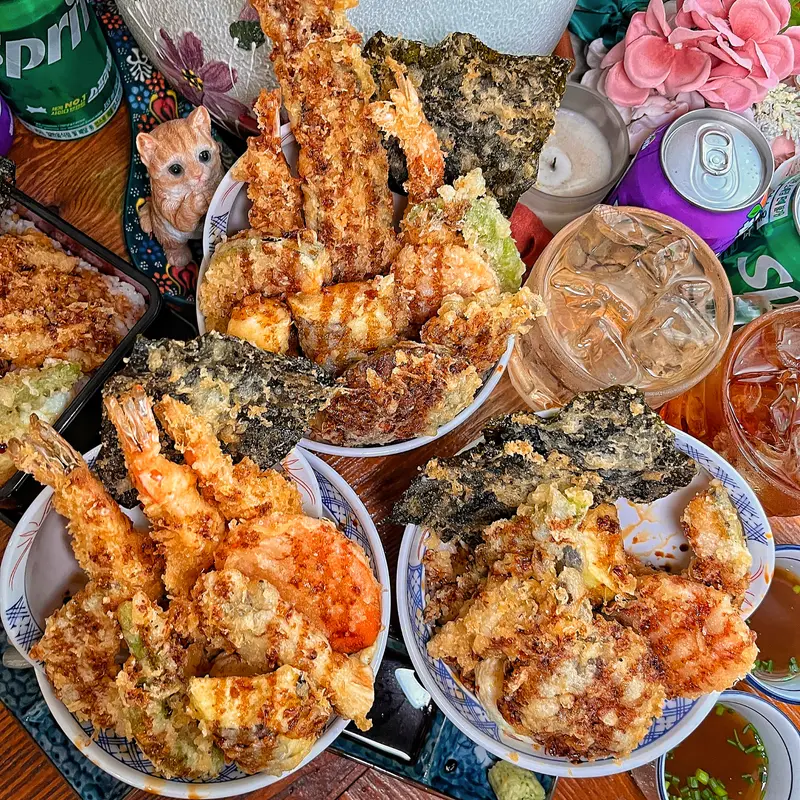
A tendon (tempura rice bowl) restaurant on the main street of Bongridan-gil, the restaurant lanes of Bonghwang-dong. This is the main (original) branch.
- Hours
- Monday to Friday 11:00 to 20:20 (last order 19:40); Saturday and Sunday 11:00 to 20:10 (last order 19:30)
- Prices
- Ohiru tendon 11,900 won, ebi tendon 14,000 won, special tendon 16,500 won, extra prawn 2,000 won
Foreigner access
- Korean name
- 오히루텐 김해본점
- Booking
- Walk-in, with a remote waiting list on Tabling
Korean phone number needed: unconfirmed - English
- Menu: unconfirmed · Signs: unconfirmed · Staff: unconfirmed
- Queue app
- Tabling
-
Gimhae Dwitgogi Street
Dwitgogi is Gimhae's own grilled pork: a mix of small cuts from the pig's head and neck (around the eyes, the cheeks, the tongue and jowl), chewy and tender, which Gimhae City lists among its nine local foods. The name, roughly back-door meat, comes from butchers who set these cuts aside and sold them on the side. The restaurants are in Bonghwang-dong and Buwon-dong.
- Hours
- Each restaurant sets its own
Foreigner access
Google Maps for Gimhae Dwitgogi Street Naver Map: unconfirmed- Korean name
- 김해 뒷고기 거리
- Booking
- Walk-in
- English
- Menu: unconfirmed · Signs: unconfirmed · Staff: unconfirmed
Hotels
Experiences
Sources
- Tongdosa: bus timetable Busan (Nopo) to Tongdosa (Sinpyeong) and back, Purun Transport (notice, 2026-02-24; Korean) (accessed 2026-11-14)
- Tongdosa: directions (Korean) (accessed 2026-11-14)
- Tongdosa: opening hours, free admission and parking (Korean) (accessed 2026-11-14)
- Tongdosa: cultural guide tours (Korean) (accessed 2026-11-14)
- Tongdosa: Diamond Precept Platform opening days (notice; Korean) (accessed 2026-11-14)
- Tongdosa: Seongbo Museum reopening and temporary admission fee (notice, 2026-09-25; Korean) (accessed 2026-11-14)
- Tongdosa: English website (history, the main hall without a statue) (accessed 2026-11-14)
- Templestay: Tongdosa, temple for foreigners, refunds and contact (accessed 2026-11-14)
- Templestay: Tongdosa Just Relaxation (price, dates, schedule, booking) (accessed 2026-11-14)
- T-money intercity bus booking: Busan Dongbu (Nopo) to Tongdosa (Sinpyeong) departures and fares (Korean) (accessed 2026-11-14)
- Korea Heritage Service: Sansa, Korea's Buddhist mountain monasteries, added to the World Heritage List (press release, 2018-06-30; Korean) (accessed 2026-11-14)
- Korea Heritage Service: Gaya Tumuli, the seven burial mound clusters (Korean) (accessed 2026-11-14)
- Gimhae City: 2026 World Heritage Festival, Gaya Tumuli listed in 2023 (press release, 2026-08-31; Korean) (accessed 2026-11-14)
- Yonhap News: Yangsan finishes work on the Tongdosa Mupung Hansong-ro pine path (2024-10; Korean) (accessed 2026-11-14)
- Gyeongnam Domin Ilbo: Tongdosa Mupung Hansong-ro pine path reopens after work, 1.2 km, 2018 Beautiful Forest award (2024-10-03; Korean) (accessed 2026-11-14)
- Gimhae Tourism: Royal Tomb of King Suro (hours, free admission; Korean) (accessed 2026-11-14)
- Daeseong-dong Tumuli Museum: visitor information (Korean) (accessed 2026-11-14)
- Gimhae National Museum: visitor information (Korean) (accessed 2026-11-14)
- Gimhae National Museum: directions (Korean) (accessed 2026-11-14)
- Gimhae Gaya Theme Park: admission fees (Korean) (accessed 2026-11-14)
- Gimhae Gaya Theme Park: opening hours (Korean) (accessed 2026-11-14)
- Gimhae Gaya Theme Park: shuttle bus from Injedae Station (Korean) (accessed 2026-11-14)
- Gimhae City: nine local foods of Gimhae (Korean) (accessed 2026-11-14)
- Gimhae Tourism: Gimhae dwitgogi street (Korean) (accessed 2026-11-14)
- Busan-Gimhae Light Rail: fares and transfers (updated 2025-09-22; Korean) (accessed 2026-11-14)
- Busan-Gimhae Light Rail: first and last trains (Korean) (accessed 2026-11-14)
- Korea Tourism Organization (TourAPI): Tongdosa, Tongdosa Seongbo Museum, Royal Tomb of King Suro, Daeseong-dong Tumuli Museum, Gimhae National Museum, Gimhae Gaya Theme Park (Korean; search by name) (accessed 2026-11-14)
- Naver Place: Gyeonggi Sikdang (hours, menu, history) (accessed 2026-11-14)
- Naver Place: Ohiruten Gimhae main branch (hours, menu, Tabling) (accessed 2026-11-14)
- Naver Place: Gimhae National Museum (walk from Bakmulgwan Station, reopening of the permanent exhibition) (accessed 2026-11-14)
- Naver Place: Daeseong-dong Tumuli Museum (walk from Bakmulgwan Station) (accessed 2026-11-14)
- Naver Place: Royal Tomb of King Suro (walk from Surowangneung Station) (accessed 2026-11-14)
- Naver blog: Nopo to Tongdosa by bus on a Saturday, a full bus, lunch in the temple dining hall (2026-11-09) (accessed 2026-11-14)
- Naver blog: buying the Tongdosa bus ticket at the intercity counter, unreserved seats (2026-11-03) (accessed 2026-11-14)
- Naver blog: Tongdosa by bus with a transit card, lunch in the dining hall, walking back to Sinpyeong (2026-10-01) (accessed 2026-11-14)
- Naver blog: Tongdosa bus with a transit card, full buses, lunch in the dining hall (2026-10-08) (accessed 2026-11-14)
- Naver blog: Tongdosa by bus, paying with a transit card when getting off, the pine path (2026-08-31) (accessed 2026-11-14)