Choryang and the Busan Station Area
Across from the KTX station: Chinatown dumplings, the 168 Stairs and their free elevator, and old Busan restaurants
Intro
Choryang is the neighborhood directly across the road from Busan Station, the KTX terminus. Step out of Exit 1 and you are at the gate of Busan Chinatown, where Sinbalwon has made dumplings since 1951; behind it the land rises steeply into the hillside neighborhoods where refugees settled during the Korean War. Choryang Ibagu-gil, a 1.5 km walking route, climbs from the station up through those lanes, and its best-known stretch is the 168 Stairs, now with a free inclined elevator beside them. The lanes at the bottom are full of places to eat before a train: milmyeon, pork soup, a pork and noodle house in the Michelin Guide, dumplings and 24-hour grilled pork.
It is a neighborhood for half a day, before or after a train, rather than a day of its own. On another day, Busanjin Market, a fabric and wedding goods market, is 4 stops up Line 1, and Beomeosa, a large mountain temple, is near the northern end of Line 1 (see Further afield below).
Half a day from Busan Station
A route that works:
- Start at the bottom: from Busan Station, cross to Chinatown (Exit 1) and walk past the dumpling houses to the Former Baekje Hospital (Exit 7 side), where you can have a coffee inside a 1927 brick building.
- Ride up: walk to the foot of the 168 Stairs, about 10 minutes from Exit 7, and take the Haneulgil elevator up. Get off halfway at Kim Min-bu Observatory if you want the view from there.
- Along the top: Myeongnan Brand Lab is next to the top stop. From there, walk on to Ibagu Gongjakso and its roof terrace a short way along the slope. Yu Chi-hwan’s Postbox is further along Mangyang-ro.
- Walk down the stairs: or take the elevator back down; the stairs are steep, and going down is hard on the knees.
- Eat before or after: pork and noodles at Pyeongsanok, pork soup at Bonjeon, or dumplings in Chinatown, by the station.
November 2026 blog posts go both ways: one rides the elevator up and walks down; another says most people ride up and walk down, though it took the elevator down itself; a third walked up and rode down. A recent blog post allows about 1.5 to 2 hours for the basic walk from the Former Baekje Hospital to Ibagu Gongjakso, without meals. Busan-based creator junfrombusan takes a similar loop in the other direction, starting with noodles at Pyeongsanok and going up to 168 Dosirakguk, then back down to Choryang Traditional Market.
Busan Station and Chinatown
Busan Chinatown starts at the red gate across the main road from Busan Station. Chinese shops gathered here after the Qing dynasty opened a consulate in 1884, and the street was renamed Shanghai Street after Busan and Shanghai became sister cities in 1993. Dumpling houses are the reason to come: Sinbalwon (since 1951) and Maga Mandu are a few doors apart, and Hongseongbang, just inside the gate, is the place to sit down for boiled dumplings and a full Chinese meal. A 2021 Seoul Shinmun article describes the street below Chinatown, known as Texas Street, as a nightlife area of bars with Russian and Filipino signs, which grew from the bars that opened when American troops arrived after Japanese rule ended; it is not a sightseeing spot.
Walking north from Chinatown toward the stairs, the Former Baekje Hospital was built in 1927 as Busan’s first modern private general hospital, and its first two floors are now a cafe. Across the main road, Choryang Milmyeon serves Busan’s cold wheat noodles, and Choryang Traditional Market, near Exit 1 of Choryang Station, is a market in a building, opened in 1975, selling raw fish, bedding and other everyday goods.
Ibagu-gil and the 168 Stairs
Ibagu-gil is a marked route rather than one path. Dong-gu District numbers its stops: the brick wall left from Namseon Warehouse, where pollock shipped from the north was stored in the early 1900s; the Former Baekje Hospital; a gallery of old photos and a wall of local figures along Choryang Elementary School; the 168 Stairs, with Kim Min-bu Observatory and 168 The Deck; then, along the top, Myeongnan Brand Lab, Ibagu Gongjakso, the Mangyang-ro Hillside Road Exhibition Hall, the Jang Gi-ryeo Memorial The Nanum Center, Ibagu Camp and Yu Chi-hwan’s Postbox.
The 168 Stairs are the steep center of the route. In the war years they were the only path between the lower and upper village, and residents carried water up them from wells at the bottom. One of the three wells is still there.
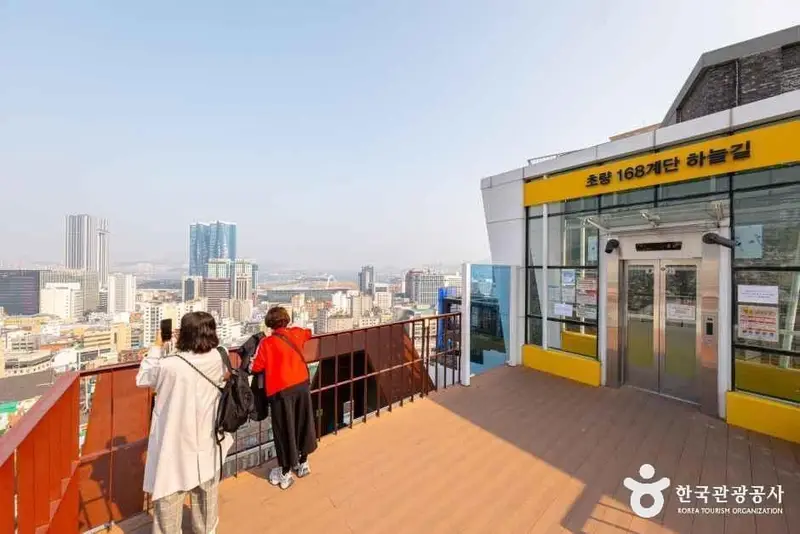
The monorail is gone. The red monorail that used to run beside the stairs broke down often and has been replaced by the Choryang 168 Stairs Haneulgil (초량168계단 하늘길), an inclined elevator that opened on March 11, 2025. It is free, carries about 12 people and has three stops: the 168 Stairs Culture Exhibition Space at the bottom, Kim Min-bu Observatory halfway up and Myeongnan Brand Lab and 168 The Deck at the top. Dong-gu does not list separate hours for the elevator; call 051-440-4781 (Dong-gu Office, Korean) before you go. A November 2026 blog post says there can be a line for the elevator. The stairs themselves are open at all times.
168 The Deck, at the top of the elevator, is a deck facing the North Port. From March to November, Dong-gu runs events there such as outdoor film screenings with wireless headphones, announced one by one; the deck itself is open at all times.
Along the top: Mangyang-ro
The upper half of Ibagu-gil follows Mangyang-ro, the road along the hillside. Besides Myeongnan Brand Lab, Ibagu Gongjakso and Yu Chi-hwan’s Postbox (see the cards), there are two small museums:
- Mangyang-ro Hillside Road Exhibition Hall (488 Mangyang-ro): an archive of refugee life on Busan’s hillside roads, with media art. Tuesday to Saturday 10:00 to 19:00, Sunday 9:00 to 18:00, closed on Mondays and public holidays.
- Jang Gi-ryeo Memorial The Nanum Center (48 Yeongchoyut-gil): an exhibition on Dr. Jang Gi-ryeo, the doctor known in Korea as the Korean Schweitzer. Same hours, closed on Mondays and public holidays.
This is a residential neighborhood. Keep your voice down in the lanes and on the stairs, and do not stand in front of doorways or the school gate.
Food and drink
- Milmyeon (cold wheat noodles): Choryang Milmyeon, 7,000 won (small) or 8,000 won (large), with large dumplings for 7,000 won. No afternoon break.
- Dwaeji gukbap (pork and rice soup): Bonjeon Dwaeji Gukbap, 11,000 won, from 8:40.
- Boiled pork and noodles: Pyeongsanok, in the Michelin Guide, pork 11,000 won and noodles 3,000 won. Closed on Sundays and between 15:00 and 16:30.
- Dumplings: Sinbalwon, 4,800 to 6,500 won for four (closed on Tuesdays); Maga Mandu, 8,000 won a plate (closed on Wednesdays); Hongseongbang, boiled dumplings 8,000 won.
- Bulbaek (grilled marinated pork with rice): Choryang Wonjo Bulbaek, 11,000 won, open 24 hours.
- On the stairs: 168 Dosirakguk, an old-style packed lunch for 6,000 won, until 14:00.
- Coffee: Brown Hands Baekje in the Former Baekje Hospital (americano 6,300 won), or the unstaffed cafe in Myeongnan Brand Lab at the top.
For more about pork soup and milmyeon, and other Busan restaurants, see Where Busan Locals Eat.
When to go
| Day | Closed |
|---|---|
| Monday | Most indoor places along the top of Ibagu-gil |
| Tuesday | Sinbalwon |
| Wednesday | Maga Mandu |
| Sunday | Pyeongsanok, Busanjin Market |
Tuesday to Saturday is the best time, when the places along the top are open and the restaurants at the bottom are not all closed at once. The stairs, decks and viewpoints are open every day. For the view of the harbor lights, Yu Chi-hwan’s Postbox and the decks are open after dark. Dong-gu does not list separate hours for the elevator; call 051-440-4781 (Dong-gu Office, Korean) before you go. If it is not running, walk down the stairs.
Getting there
From Busan Station. Chinatown is under a minute from Exit 1. For the stairs, it is about 650 m (15 minutes) on foot from Exit 5, or about 10 minutes from Exit 7.
From elsewhere in Busan. Take Line 1 to Busan Station or Choryang Station, one stop apart. From Nampo it is 2 stops (1,600 won with a transit card).
Luggage. The stairs and slopes are hard work with a suitcase. Leave it in a coin locker at Busan Station first; see the 2-day Busan itinerary for locker prices.
Further afield: Beomeosa Temple
Beomeosa is a large temple on the slopes of Geumjeongsan, founded in 678 and counted with Haeinsa and Tongdosa as one of the three great temples of the Yeongnam region. Admission is free and it is open from 8:00 to 17:00. November, when its ginkgo trees and maples turn, is a busy time with Korean visitors.
To get there, take Line 1 north from Busan Station to Beomeosa Station without changing (zone 2, 1,800 won with a transit card). From Exit 5 or 7, walk under 5 minutes to the bus stop in front of BI Mart and take bus 90 to the Beomeosa ticket office stop, about 3.5 km. Bus 90 also runs from the stop outside Exit 2 of Nopo Station, the end of the line. In the morning from Monday to Saturday, the temple’s own shuttle bus leaves from Exit 3 of Beomeosa Station at 7:10, 7:40, 8:10, 8:40, 9:10 and 9:40. For the shuttle’s return times, check the temple’s official directions page (Korean) before you go.
For the fortress walls above the temple, Sanseong Village and the Dongnae hot springs, see Beomeosa Temple and Geumjeongsan.
Common questions
- Is the 168 Stairs monorail still running? No. It has been replaced by the Haneulgil inclined elevator, which opened in March 2025 and is free. Dong-gu does not list separate hours for the elevator; call 051-440-4781 (Dong-gu Office, Korean) before you go.
- What is there to do near Busan Station? Chinatown’s dumpling houses are across the road from Exit 1, and the 168 Stairs and Ibagu-gil viewpoints are 10 to 15 minutes’ walk away. Allow half a day with a meal.
- What are Busan Chinatown’s opening hours? The street is open at all times; each restaurant sets its own hours and closing day.
- When is Busanjin Market open? Monday to Saturday, 7:00 to 19:00. Closed on Sundays.
- How much is Beomeosa’s entrance fee? It is free.
- How do I get to Beomeosa from Busan Station? Line 1 to Beomeosa Station without changing, then bus 90 from near Exit 5 or 7, or the temple shuttle from Exit 3 in the morning.
- Is Beomeosa worth visiting? If you want to see one large mountain temple in Busan, yes: it is one of the three great temples of the region and is reached by subway and a short bus ride. For a temple by the sea, see Haedong Yonggungsa.
Practical information
- Shoes: the stairs are steep, and the rest of Ibagu-gil is slopes and steps.
- Booking: none of the restaurants on this page need a booking. Sinbalwon’s takeaway is ordered through Naver, which may need a Korean phone number; eating in does not. See booking without a Korean phone number.
- Where to stay: the area around Busan Station and Nampo is the nearest base; see Where to stay in Busan.
- Nearby: Nampo and Jagalchi, 2 stops south; Gamcheon Culture Village, another hillside refugee neighborhood; and the 2-day Busan itinerary, which starts with lunch at Choryang Milmyeon. Back to the Busan guide.
Get There
-
Busan StationBusan Metro Line 1, KTX
- Korean
- 부산역
- Exit
- unconfirmed
- Walk
- unconfirmed
Exit 1 for Chinatown (under 1 minute), Hongseongbang and Pyeongsanok. Exit 5 for Sinbalwon and Maga Mandu, and the 168 Stairs about 650 m (15 minutes) away. Exit 6 for Bonjeon Dwaeji Gukbap. Exit 7 for the Former Baekje Hospital and Choryang Milmyeon; a 2026 news article puts the foot of the 168 Stairs about 10 minutes from Exit 7.
-
Choryang StationBusan Metro Line 1
- Korean
- 초량역
- Exit
- Exit 1
- Walk
- unconfirmed
One stop north of Busan Station. Closer to Choryang Traditional Market and the bulbaek (grilled pork) street.
-
Beomil StationBusan Metro Line 1
- Korean
- 범일역
- Exit
- Exit 2
- Walk
- 6 min
For Busanjin Market, 4 stops north of Busan Station.
-
Beomeosa StationBusan Metro Line 1
- Korean
- 범어사역
- Exit
- Exit 5 or 7
- Walk
- unconfirmed
For Beomeosa Temple, about 19 km north of Busan Station on the same line, then bus 90.
Hours & Fees
- Subway
- 1,600 won with a transit card from Busan Station to Choryang or Beomil (zone 1); 1,800 won to Beomeosa (zone 2)
- Ibagu-gil and the 168 Stairs
- Open at all times, free
- Haneulgil inclined elevator
- Free. Dong-gu does not list separate hours for the elevator; call 051-440-4781 (Dong-gu Office, Korean) before you go
- Mondays
- Most indoor places along the top of Ibagu-gil are closed: Myeongnan Brand Lab, Ibagu Gongjakso, the inside of Yu Chi-hwan's Postbox, the Mangyang-ro exhibition hall and the Jang Gi-ryeo center. The stairs, decks and viewpoints stay open
Places by area
Busan Station and Chinatown
-
Busan Chinatown (Shanghai Street)
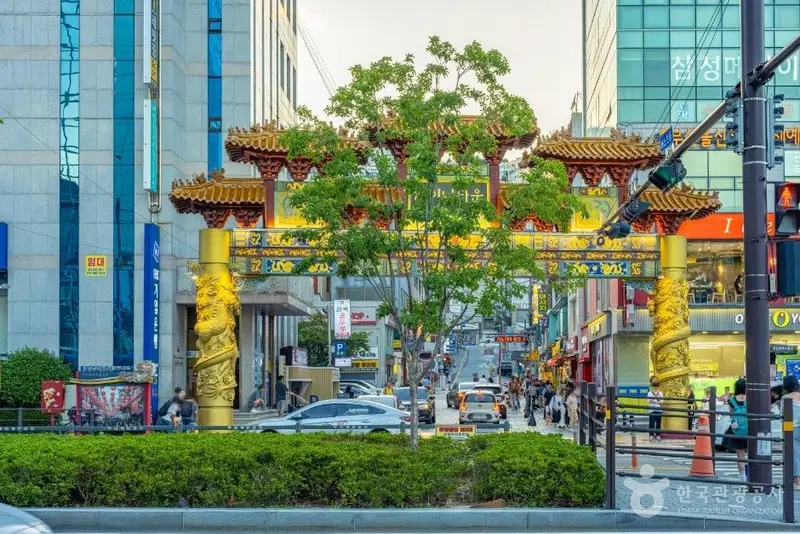
The street of Chinese restaurants and dumpling shops directly across the main road from Busan Station, entered through a red gate. It began when the Qing dynasty opened a consulate here in 1884, on the site of today's overseas Chinese school, and Chinese shops gathered around it. After Busan and Shanghai became sister cities in 1993, it was renamed Shanghai Street. Dong-gu District notes Russian and Indian-style restaurants here too. The Busan Chinatown Culture Festival is held each autumn, usually in October.
- Hours
- The street is open at all times; each shop sets its own hours
- Admission
- Free
- Toilets
- Yes
Foreigner access
- Korean name
- 부산 차이나타운
Foreigner access details not yet confirmed
-
Former Baekje Hospital (Brown Hands Baekje)
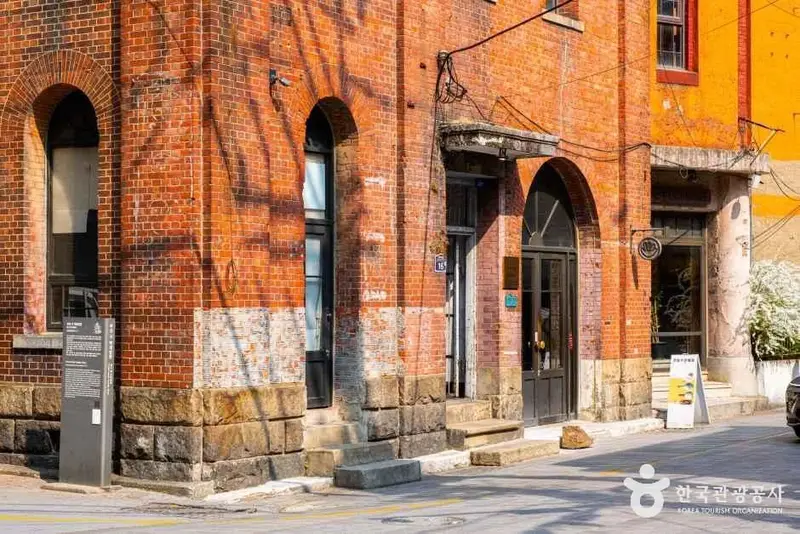
A red-brick building from 1927, two minutes from Exit 7 of Busan Station, that was Busan's first modern private general hospital. After the hospital closed it was a Chinese restaurant, quarters for Japanese army officers, a security command, the temporary embassy of the Republic of China and a wedding hall; a fire in 1972 took off the fifth floor. It is a registered national heritage building. The first and second floors are now a cafe, so the price of a coffee gets you inside.
- Hours
- Cafe 10:00 to 21:30 daily, last order 21:20. Only the 1st and 2nd floors are open
- Admission
- Free
- Cafe prices
- Americano 6,300 won, cafe latte 6,800 won, espresso 5,800 won
Foreigner access
Google Maps for Former Baekje Hospital (Brown Hands Baekje) Naver Map for Former Baekje Hospital (Brown Hands Baekje)- Korean name
- 브라운핸즈 백제
- Booking
- Walk-in
- English
- Menu: unconfirmed · Signs: unconfirmed · Staff: unconfirmed
- Queue app
- none
-
Choryang Milmyeon
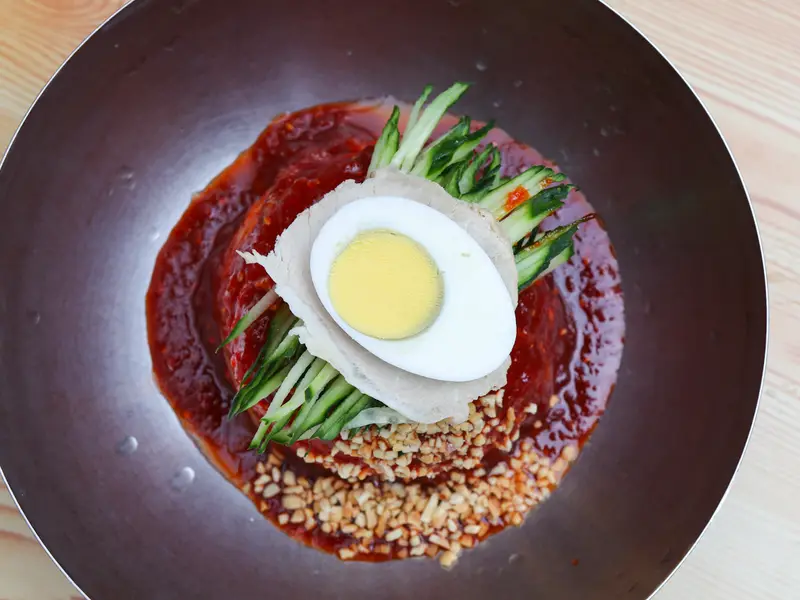
A milmyeon (Busan cold wheat noodle) restaurant across the road from Busan Station, 4 minutes from Exit 7. The restaurant describes its icy broth as simmered with herbal medicine ingredients, and its bibim (spicy) milmyeon is topped with crushed peanuts. Its other well-known dish is wang-mandu, large dumplings filled with chopped vegetables and meat. There is no afternoon break, which suits a meal before or after a train.
Featured on Ttungchi Sikdang Busan-Pig (YouTube)
- Hours
- 10:00 to 21:30 daily, last order 21:00, no break
- Prices
- Mul (in broth) or bibim milmyeon 7,000 won small, 8,000 won large; wang-mandu 7,000 won; kalguksu 7,000 won
Foreigner access
- Korean name
- 초량밀면
- Booking
- Walk-in
- English
- Menu: unconfirmed · Signs: unconfirmed · Staff: unconfirmed
- Queue app
- none
-
Bonjeon Dwaeji Gukbap
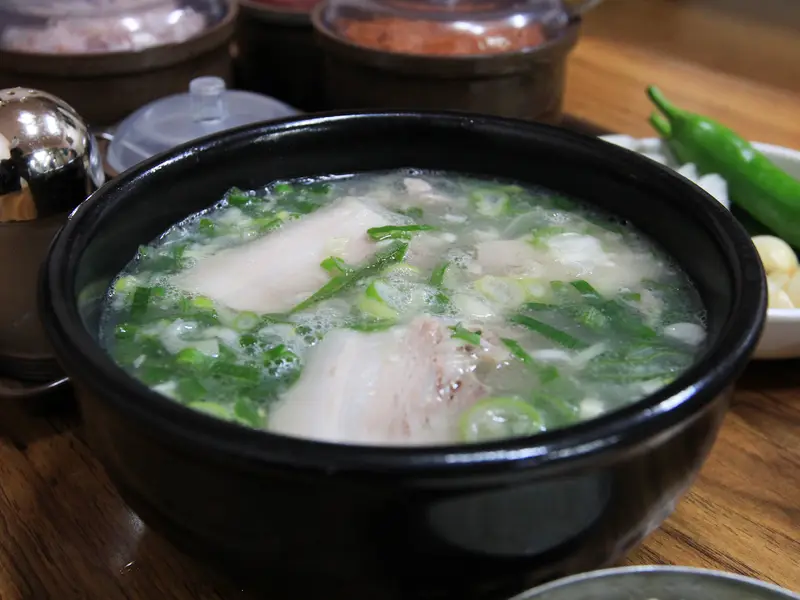
A dwaeji gukbap (pork and rice soup) restaurant in the lanes opposite Busan Station, 4 minutes from Exit 6. Korean food YouTubers have featured it as a Busan pork soup restaurant, and it opens at 8:40, early enough for a first meal off a morning train. Besides the plain pork soup there are versions with sundae (blood sausage) or offal, and a boiled pork set.
Featured on Hong Seok-cheon and Lee Won-il (YouTube) · higaengs (YouTube)
- Hours
- 8:40 to 21:00 daily, last order 20:30
- Prices
- Pork, sundae or offal gukbap 11,000 won each; boiled pork set (suyuk baekban) 14,000 won; boiled pork platter 30,000 to 50,000 won
Foreigner access
- Korean name
- 본전돼지국밥
- Booking
- Walk-in
- English
- Menu: unconfirmed · Signs: unconfirmed · Staff: unconfirmed
- Queue app
- none
-
Pyeongsanok
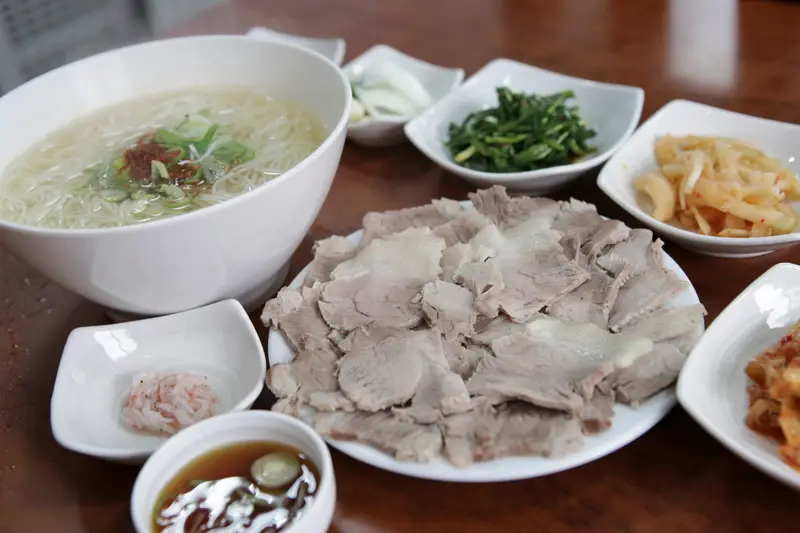
A family restaurant run by four generations, 4 minutes from Exit 1 of Busan Station, that serves only two things: boiled pork (suyuk) and noodles in broth (guksu), with yeolmu (young radish) noodles in summer. The restaurant calls itself a 100-year-old pork house, and it is listed in the Michelin Guide. The pork comes with shredded radish, seasoned chives and a house sauce; the restaurant suggests adding radish and chive kimchi to the noodles, and salted shrimp if they need salt. The noodles are 3,000 won.
Featured on MICHELIN Guide · junfrombusan (YouTube) · Chyureupkyeon (YouTube)
- Hours
- Monday to Saturday 11:00 to 20:00, break 15:00 to 16:30, closed on Sundays. Closes early when the food runs out
- Prices
- Boiled pork 11,000 won, noodles 3,000 won, yeolmu noodles (seasonal) 4,000 won
Foreigner access
- Korean name
- 평산옥
- Booking
- Walk-in
- English
- Menu: unconfirmed · Signs: unconfirmed · Staff: unconfirmed
- Queue app
- none
-
Sinbalwon
A Chinatown dumpling house in front of the overseas Chinese school, 2 minutes from Exit 5 of Busan Station, run by the same family for three generations since 1951. Dumplings are made to order: pork, pan-fried, shrimp and chive-and-glass-noodle, four to a plate, plus a set of three kinds (gogunsae) and kongguk (soy milk soup) with crackers. Takeaway is handled by the annex next door, Sinbalwon Oejeon, with orders placed through Naver.
Featured on Manduduk (YouTube) · higaengs (YouTube)
- Hours
- 11:00 to 20:45, last order 20:15, closed on Tuesdays
- Prices
- Pork dumplings 4,800 won, pan-fried dumplings 5,500 won, shrimp dumplings 6,500 won (4 each); gogunsae set 8,500 won; kongguk with crackers 4,500 won; steamed bun 3,800 won
Foreigner access
- Korean name
- 신발원
- Booking
- Walk-in to eat in. Takeaway is ordered through Naver for pickup at the annex
Korean phone number needed: unconfirmed - English
- Menu: unconfirmed · Signs: unconfirmed · Staff: unconfirmed
- Queue app
- none
-
Maga Mandu
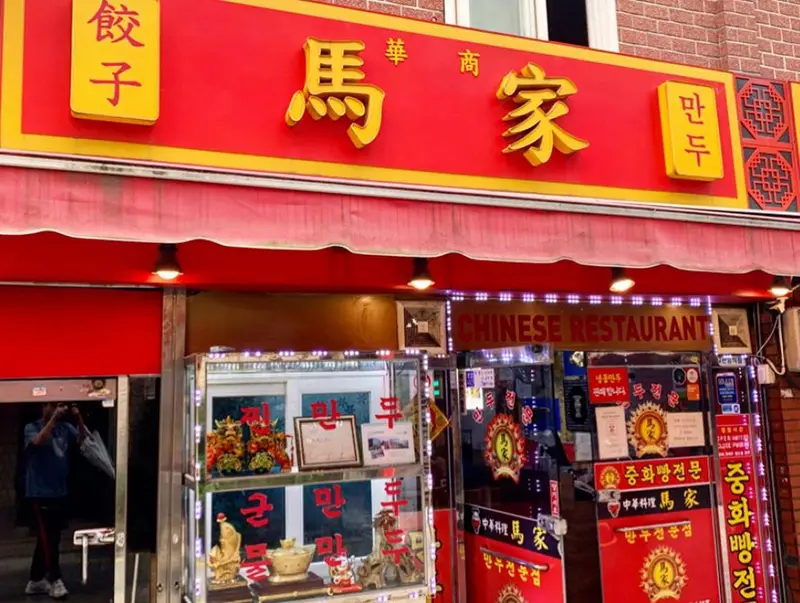
A Chinese dumpling restaurant a few doors from Sinbalwon, 2 minutes from Exit 5 of Busan Station. Pan-fried, steamed and boiled dumplings are 8,000 won a plate, and the menu goes on to fried rice, jjamppong rice (spicy seafood soup with rice), mapo tofu and sweet and sour pork, so it works as a full meal rather than a snack.
Featured on Myeonbujang (YouTube) · Manduduk (YouTube)
- Hours
- 11:00 to 21:00, break 15:00 to 16:00, closed on Wednesdays
- Prices
- Pan-fried, steamed or boiled dumplings 8,000 won; fried rice 8,000 won; jjamppong rice 9,000 won; mapo tofu 12,000 won; sweet and sour pork 28,000 won
Foreigner access
- Korean name
- 마가만두
- Booking
- Walk-in
- English
- Menu: unconfirmed · Signs: unconfirmed · Staff: unconfirmed
- Queue app
- none
-
Hongseongbang (main restaurant)
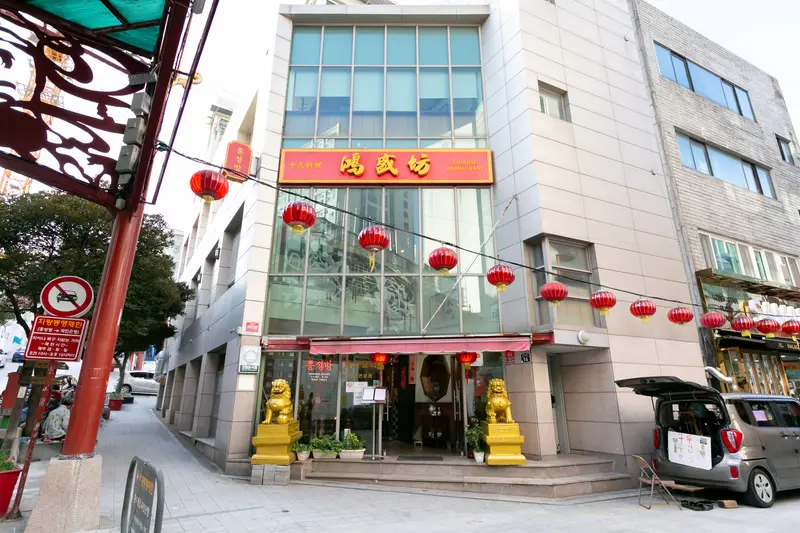
A three-floor Chinese restaurant just inside Chinatown, 3 minutes from Exit 1 of Busan Station, run by the same family for three generations and 50 years. Boiled dumplings (mul-mandu), made by hand every day, are what it is known for; there are also noodles and set lunches for two or more for a sit-down Chinese meal. The restaurant points out that another place called Hongseongbang Bonjeom on the main road is a different business; this one is at 16 Jungang-daero 179beon-gil.
Featured on Myeonbujang (YouTube)
- Hours
- 11:00 to 21:00 daily, break 15:00 to 17:00, last order 20:30
- Prices
- Boiled, pan-fried or steamed dumplings 8,000 won; dumpling soup 9,000 won; jajangmyeon 7,000 won; seafood jjamppong 9,000 won; set lunches for two or more 18,000 to 20,000 won
Foreigner access
- Korean name
- 홍성방 본점
- Booking
- Walk-in
- English
- Menu: unconfirmed · Signs: unconfirmed · Staff: unconfirmed
- Queue app
- none
-
Choryang Wonjo Bulbaek
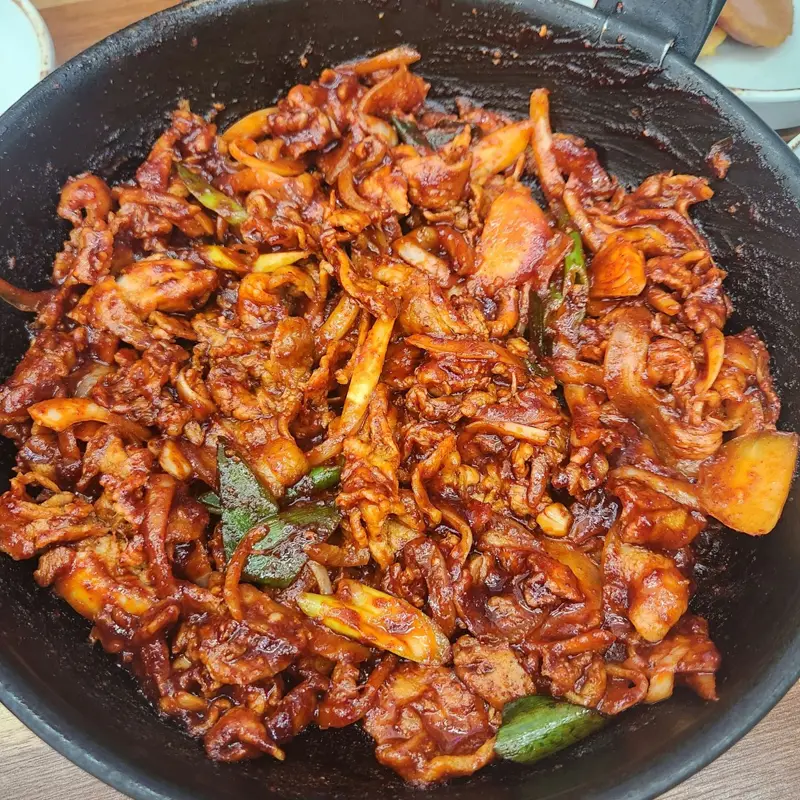
A bulbaek restaurant on the street Dong-gu District calls Choryang Galbi and Bulbaek Street, 7 minutes from Exit 1 of Choryang Station. Bulbaek is sweet marinated pork grilled on an iron plate and eaten with rice and side dishes; this restaurant has served it in the same spot since 1986. It is open 24 hours, so it works after a late train. Fish cake stew and pork stew sets are the other choices.
Featured on higaengs (YouTube)
- Hours
- Open 24 hours, every day
- Prices
- Wonjo bulbaek set, spicy chili bulbaek or soy sauce bulbaek 11,000 won; fish cake stew set or pork stew 9,000 won
Foreigner access
- Korean name
- 초량원조불백
- Booking
- Walk-in
- English
- Menu: unconfirmed · Signs: unconfirmed · Staff: unconfirmed
- Queue app
- none
Ibagu-gil (the hillside)
-
Choryang Ibagu-gil
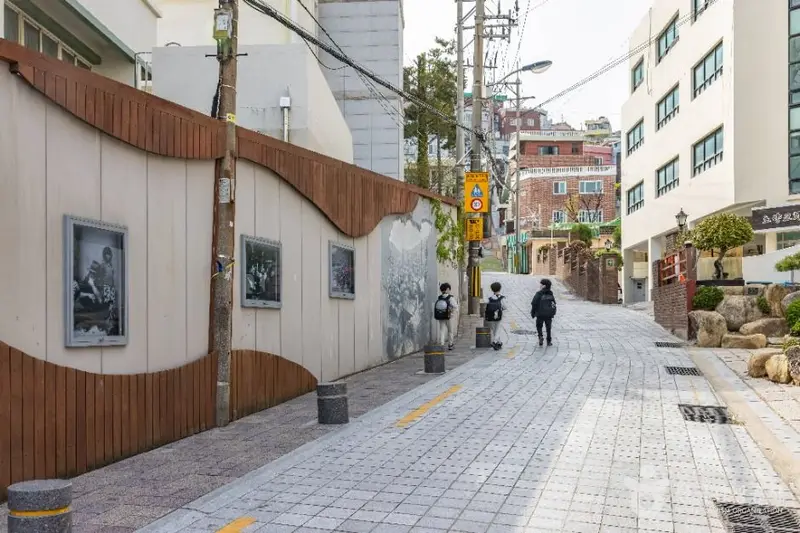
A 1.5 km walking route from the streets opposite Busan Station up the hillside to Mangyang-ro, the road that runs along the slope. Ibagu means story in the Busan dialect. The route keeps traces of the 1950s and 1960s, when refugees from the Korean War settled on these slopes, and of the industrial boom of the 1970s and 1980s. Dong-gu District marks the stops in order: the site of Namseon Warehouse (Busan's first logistics warehouse, which stored pollock; only a red-brick wall is left) and the Former Baekje Hospital, the photo gallery on the wall of Choryang Elementary School, the 168 Stairs and Haneulgil elevator, Kim Min-bu Observatory and 168 The Deck, then Myeongnan Brand Lab, Ibagu Gongjakso and the other stops along the top. People live here.
- Hours
- The route is open at all times. Indoor places along it set their own hours; most close on Mondays
- Admission
- Free
- Etiquette
- Residents' homes and a school: keep your voice down and keep doorways and school gates clear
Foreigner access
- Korean name
- 초량이바구길
- English
- Signs: Partly
The sign at Kim Min-bu Observatory is in Korean and English. Whether the rest of the route has English signs has not been confirmed.
-
168 Stairs and the Haneulgil inclined elevator
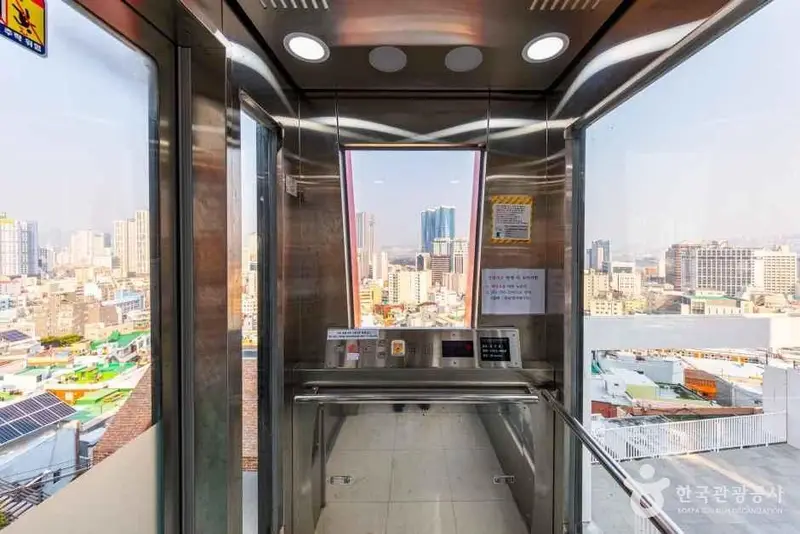
The 168 steps climb a slope of up to about 40 degrees, as high as a six-story building, and are the quickest way from the harbor up to the hillside road. During the Korean War they were the only path between the upper and lower village, and residents carried water up from wells at the bottom; one of the three wells is still there. Beside the stairs, the Haneulgil inclined elevator replaced the old monorail, which had broken down often. It opened on March 11, 2025, holds about 12 people, runs about 60 m and is free. It stops at the 168 Stairs Culture Exhibition Space at the bottom, Kim Min-bu Observatory halfway up and Myeongnan Brand Lab and 168 The Deck at the top.
Featured on Busan MBC News (YouTube)
- Stairs
- Open at all times, free
- Haneulgil elevator
- Free. Dong-gu does not list separate hours for the elevator; call 051-440-4781 (Dong-gu Office, Korean) before you go
- Lines
- A November 2026 blog post says there can be a line for the elevator
- From Busan Station
- About 650 m (15 minutes) from Exit 5, or about 10 minutes from Exit 7, to the foot of the stairs
Foreigner access
Google Maps for 168 Stairs and the Haneulgil inclined elevator Naver Map for 168 Stairs and the Haneulgil inclined elevator- Korean name
- 초량168계단
Foreigner access details not yet confirmed
-
Kim Min-bu Observatory
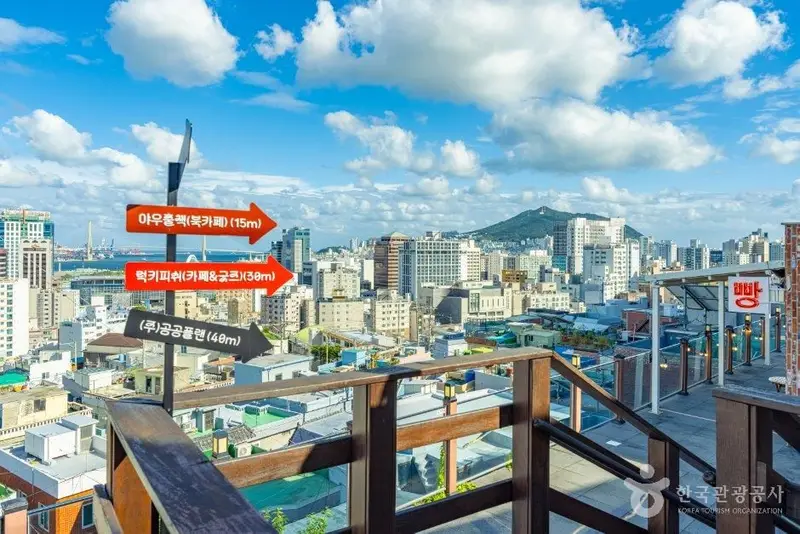
A small viewing deck halfway up the 168 Stairs, at the middle stop of the Haneulgil elevator, looking over the rooftops to Busan Port and Busan Harbor Bridge. It is named after Kim Min-bu, a poet from Dong-gu who wrote the lyrics of the art song Gidarineun Maeum (The Waiting Heart), which is written on the wall here; he also created Jagalchi Ajimae, a long-running Busan MBC radio program. The sign at the deck is in Korean and English.
- Hours
- Open at all times
- Admission
- Free
Foreigner access
- Korean name
- 김민부전망대
- English
- Signs: Yes
-
Myeongnan Brand Lab
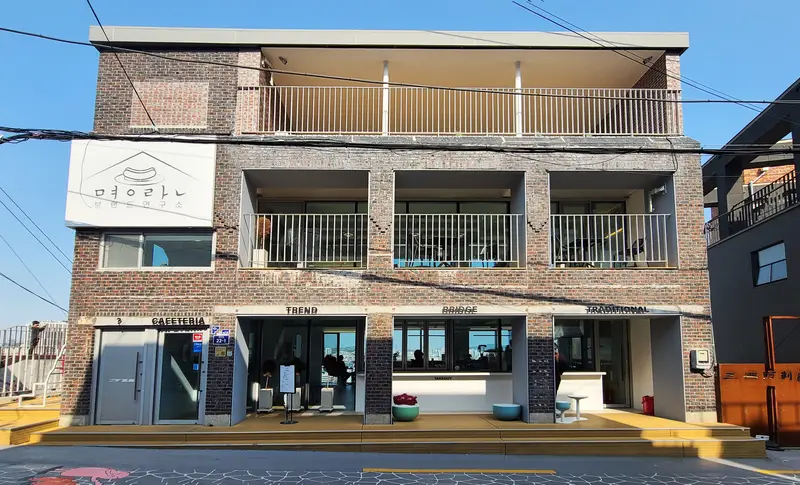
A building run around myeongnan (salted pollock roe, a Busan specialty) next to the top stop of the Haneulgil elevator. By Dong-gu District's description, the 1st floor serves ramyeon, the 2nd sells pollock roe products and the souvenirs of its Myeongnan Siblings characters, the 3rd has an unstaffed cafe and a photo booth, and the 4th and 5th floors are for the view. Many Korean visitors turn back here and walk down the stairs.
- Hours
- Tuesday to Sunday 10:00 to 19:00, closed on Mondays. Dong-gu District also lists it as closed on public holidays; its Naver listing shows Mondays only
- Admission
- Free to walk in; food and goods are paid for
- Prices
- Pollock roe, 500 g value pack 10,000 won
- Phone
- 051-462-9182 (Korean)
Foreigner access
- Korean name
- 명란브랜드연구소
- English
- Menu: unconfirmed · Signs: unconfirmed · Staff: unconfirmed
- Queue app
- none
-
Ibagu Gongjakso
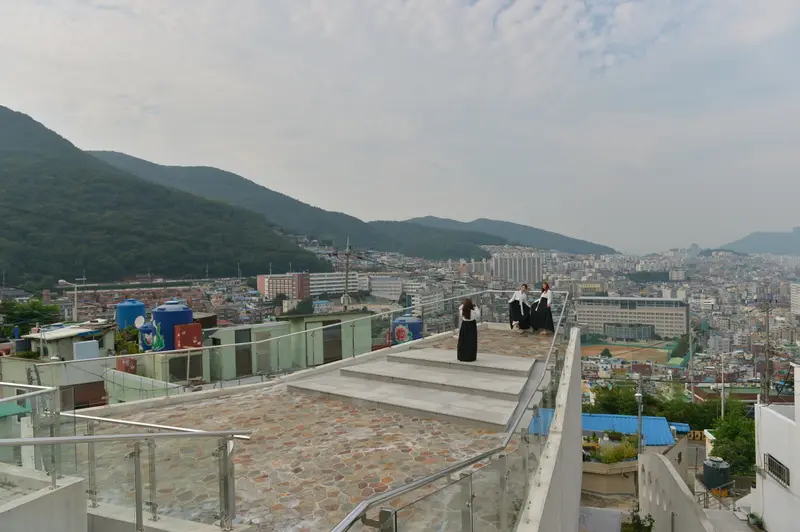
A small archive of life on Busan's hillside roads, a short walk up from the top of the 168 Stairs, with photos and records of how refugees settled the slopes. It has a roof terrace with an open view of the North Port, and on the 1st floor you can rent an old-style Korean school uniform for photos. A good stop on a rainy day.
- Hours
- Tuesday to Saturday 10:00 to 19:00, Sunday 9:00 to 18:00; closed on Mondays and public holidays
- Admission
- Free
- School uniform
- Rental 15,000 won, or 2,000 won to try one on, according to a November 2026 blog post
Foreigner access
- Korean name
- 이바구공작소
- Booking
- Walk-in
- English
- Signs: unconfirmed · Staff: unconfirmed
-
Yu Chi-hwan's Postbox
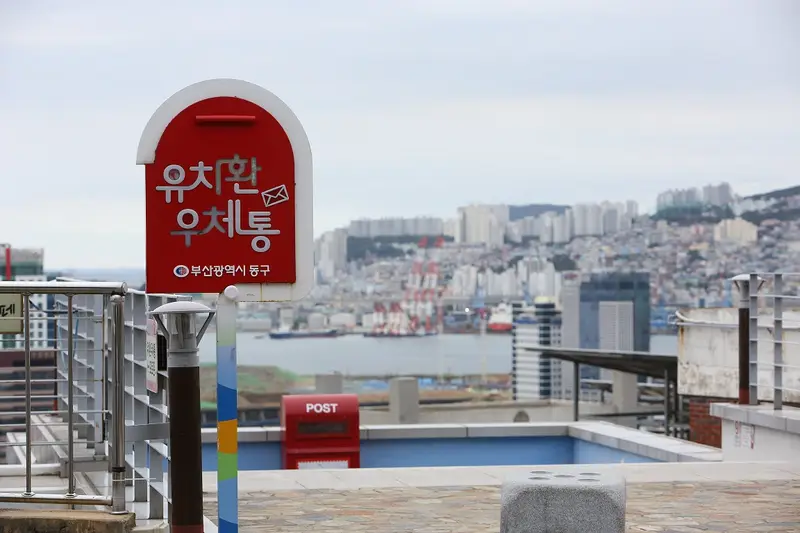
A viewpoint on Mangyang-ro at the far end of Ibagu-gil, named after the poet Yu Chi-hwan, with small galleries and a music room inside and a deck over Busan Port and Busan Harbor Bridge outside. Its slow postbox delivers a postcard one year after you post it. It is not next to Ibagu Gongjakso: allow for a longer walk along Mangyang-ro.
- Hours
- Indoor spaces Tuesday to Saturday 10:00 to 19:00, Sunday 9:00 to 18:00, closed on Mondays and public holidays (Dong-gu District). Its Naver listing also shows a 12:00 to 13:00 break from Tuesday to Saturday. The deck is open at all times
- Admission
- No charge is listed
- Phone
- 051-469-9818 (Korean)
Foreigner access
- Korean name
- 유치환의 우체통
Foreigner access details not yet confirmed
-
168 Dosirakguk
A small lunch place partway up the 168 Stairs, reached by following the wall of Choryang Elementary School. It is run as part of a jobs program for older residents, and its earnings go to their activity pay and running costs. The menu is an old-style packed lunch (dosirak) and siraegi-guk, a soup of dried radish greens with rice. It closes at 14:00, so go in the morning or at lunch.
Featured on junfrombusan (YouTube)
- Hours
- 9:30 to 14:00 daily; may change with group bookings and on the day
- Prices
- Old-style lunchbox 6,000 won, siraegi soup with rice 5,000 won, beef yukgaejang 7,000 won, kimchi fried rice 8,000 won, americano 2,000 won
Foreigner access
- Korean name
- 168도시락국
- Booking
- Walk-in
- English
- Menu: unconfirmed · Signs: unconfirmed · Staff: unconfirmed
- Queue app
- none
Busanjin Market (Beomil)
-
Busanjin Market
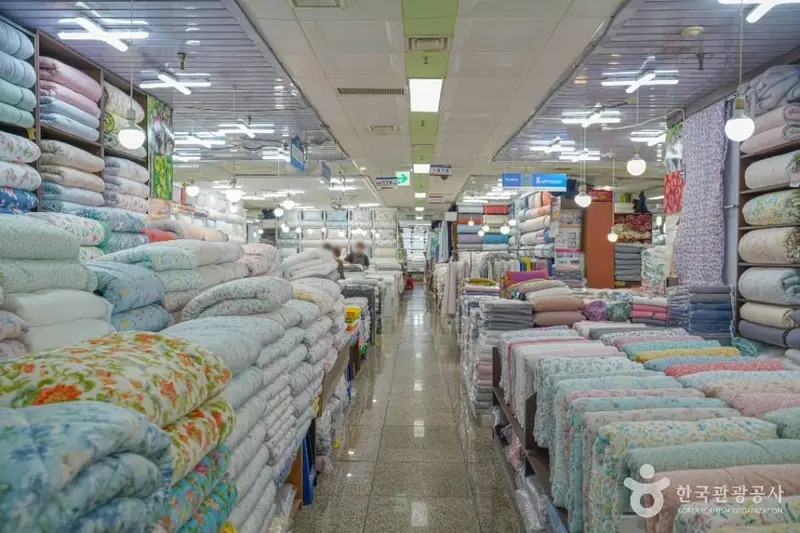
A large market building 4 stops north of Busan Station, specializing in what Korean couples buy before a wedding: hanbok (traditional clothes) and the fabric to make them, bedding and tableware, along with clothing and accessories. It began as a permanent market in 1913; the present building, with two basement floors and three above ground, went up from 1968. It has about 1,350 shops, some 600 of them for wedding goods and fabric, and is counted with Dongdaemun Market in Seoul and Seomun Market in Daegu as one of Korea's three big markets. It is mainly fabric and wedding goods; there are some seafood, butcher and snack shops, but it is not a market to visit for food.
- Hours
- Monday to Saturday 7:00 to 19:00, closed on Sundays
- Admission
- Free
- Phone
- 051-646-7041 (Korean)
Foreigner access
- Korean name
- 부산진시장
Foreigner access details not yet confirmed
Further afield
-
Beomeosa Temple
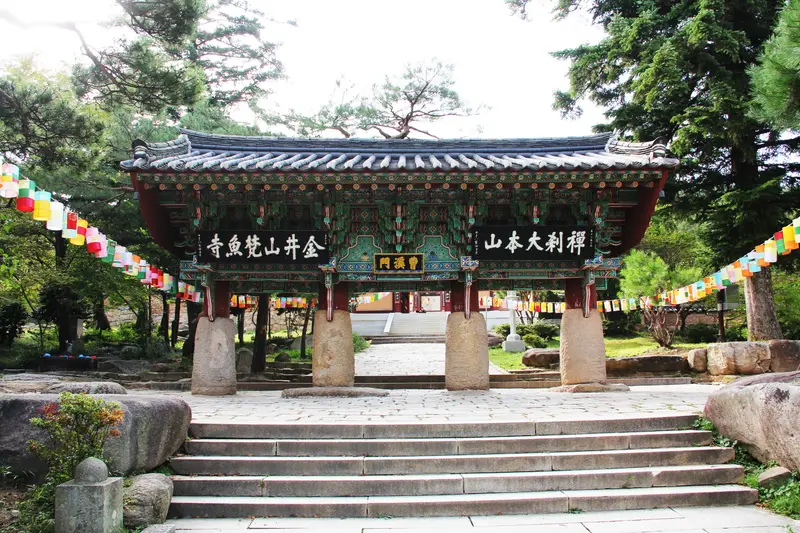
A large Buddhist temple on the lower slopes of Geumjeongsan in the north of Busan, reached by Line 1 and a short bus ride. It was founded in 678 by the monk Uisang and is counted with Haeinsa and Tongdosa as one of the three great temples of the Yeongnam region; the present buildings date from its rebuilding in 1613, after it burned during the Japanese invasions of the 1590s. It is the head temple of the 14th district of the Jogye Order. The temple's own listing says it is the only temple in Korea that holds a copy of the Samguk Yusa, a national treasure. It also runs temple stay programs.
- Hours
- 8:00 to 17:00 daily
- Admission
- Free
- Bus 90
- From the stop in front of BI Mart, under 5 minutes on foot from Exit 5 or 7 of Beomeosa Station, to the Beomeosa ticket office stop, about 3.5 km. Timetable unconfirmed
- Temple shuttle
- From Exit 3 of Beomeosa Station, Monday to Saturday at 7:10, 7:40, 8:10, 8:40, 9:10 and 9:40, with extra runs on some Buddhist observance days. Times vary with traffic
- Phone
- 051-508-3122 (temple office, Korean)
Foreigner access
- Korean name
- 범어사
- Booking
- None needed to visit
- English
- Signs: unconfirmed · Staff: Partly
An English guide is available on request in advance, and the temple has an English website.
Hotels
Experiences
Sources
- Dong-gu District, Busan: Choryang 168 Stairs (history, Haneulgil inclined elevator and its stops, Myeongnan Brand Lab floors; Korean) (accessed 2026-11-14)
- Dong-gu District, Busan: Choryang Ibagu-gil route, with addresses, hours and phone numbers of the stops along it (Korean) (accessed 2026-11-14)
- Dong-gu District, Busan: Busan Chinatown (1884 consulate, Shanghai Street, festival; Korean) (accessed 2026-11-14)
- Dong-gu District, Busan: Choryang Galbi and Bulbaek Street (Korean) (accessed 2026-11-14)
- Dong-gu District, Busan: traditional markets (Busanjin Market; Korean) (accessed 2026-11-14)
- Beomeosa: directions, bus 90 and the temple shuttle timetable (Korean) (accessed 2026-11-14)
- Beomeosa: English website (accessed 2026-11-14)
- MICHELIN Guide: Pyeongsanok (accessed 2026-11-14)
- Korea Tourism Organization (TourAPI): 168 Stairs, Kim Min-bu Observatory, Choryang Ibagu-gil, Ibagu Gongjakso, Busan Chinatown, Busanjin Market, Beomeosa, Former Baekje Hospital (Korean; search by name) (accessed 2026-11-14)
- Busan Transportation Corporation: subway fares and distances (accessed 2026-11-14)
- Twig: Choryang Ibagu-gil gets an inclined elevator from March 11, in place of the monorail (2025-02-27, Korean) (accessed 2026-11-14)
- News-wa: the free elevator at the 168 Stairs by Busan Station, its three stops (2026-07-18, Korean) (accessed 2026-11-14)
- Busan MBC News: inclined elevator opens at Choryang 168 Stairs (2025-03-05, Korean, YouTube) (accessed 2026-11-14)
- Seoul Shinmun: walking Ibagu-gil, the Texas village and Chinatown (2021-05-13, Korean) (accessed 2026-11-14)
- Naver Place: 168 Stairs (walking distance from Busan Station) (accessed 2026-11-14)
- Naver Place: Kim Min-bu Observatory (accessed 2026-11-14)
- Naver Place: Choryang Ibagu-gil (accessed 2026-11-14)
- Naver Place: Ibagu Gongjakso (hours) (accessed 2026-11-14)
- Naver Place: Yu Chi-hwan's Postbox (hours, slow postbox) (accessed 2026-11-14)
- Naver Place: Myeongnan Brand Lab (hours, menu) (accessed 2026-11-14)
- Naver Place: Brown Hands Baekje (hours, menu) (accessed 2026-11-14)
- Naver Place: Busan Chinatown (accessed 2026-11-14)
- Naver Place: Busanjin Market (hours) (accessed 2026-11-14)
- Naver Place: Beomeosa (hours, introduction, directions) (accessed 2026-11-14)
- Naver Place: Choryang Milmyeon (hours, menu) (accessed 2026-11-14)
- Naver Place: Bonjeon Dwaeji Gukbap (hours, menu) (accessed 2026-11-14)
- Naver Place: Pyeongsanok (hours, menu) (accessed 2026-11-14)
- Naver Place: Sinbalwon (hours, menu, takeaway) (accessed 2026-11-14)
- Naver Place: Maga Mandu (hours, menu) (accessed 2026-11-14)
- Naver Place: Hongseongbang main restaurant (hours, menu) (accessed 2026-11-14)
- Naver Place: Choryang Wonjo Bulbaek (hours, menu) (accessed 2026-11-14)
- Naver Place: 168 Dosirakguk (hours, menu) (accessed 2026-11-14)
- Naver blog: Chinatown, Baekje Hospital, up to Ibagu Gongjakso and the Haneulgil, dinner at Pyeongsanok (2026-11-08) (accessed 2026-11-14)
- Naver blog: up by the Haneulgil elevator to Myeongnan Brand Lab, down the 168 Stairs, half a day on foot from Busan Station (2026-11-08) (accessed 2026-11-14)
- Naver blog: pork soup by Busan Station, the Haneulgil and the 168 Stairs, weekend line (2026-11-08) (accessed 2026-11-14)
- Naver blog: lunch, then up the 168 Stairs by the Haneulgil (2026-11-10) (accessed 2026-11-14)
- Naver blog: Ibagu Gongjakso school uniform prices (2026-11-10) (accessed 2026-11-14)
- Naver blog: Ibagu-gil in about 1.5 to 2 hours, leave big luggage, the postbox is a separate walk (2026-11-09) (accessed 2026-11-14)
- Naver blog: Beomeosa by bus 90 from Exits 5 and 7, November leaves (2026-11-14) (accessed 2026-11-14)
- Naver blog: Beomeosa is free, bus 90 and the shuttle (2026-11-13) (accessed 2026-11-14)