Seoul's Hot Streets and the "-ridan-gil" Names
Where young Seoulites go out now, why so many streets end in -ridan-gil, and how Koreans find the next hot place
Intro
Korean has a borrowed word for a place everyone is talking about: hatpeul (핫플), short for “hot place”. In Seoul, hot places tend to come in whole streets, and many of those streets have names that end in -ridan-gil. This page explains where the names come from, how a street gets hot and then cools, and how Koreans find the next one. Below that are eight streets where young Seoulites go now, each with what people do there, when to go and the nearest station.
Where the “-ridan-gil” names come from
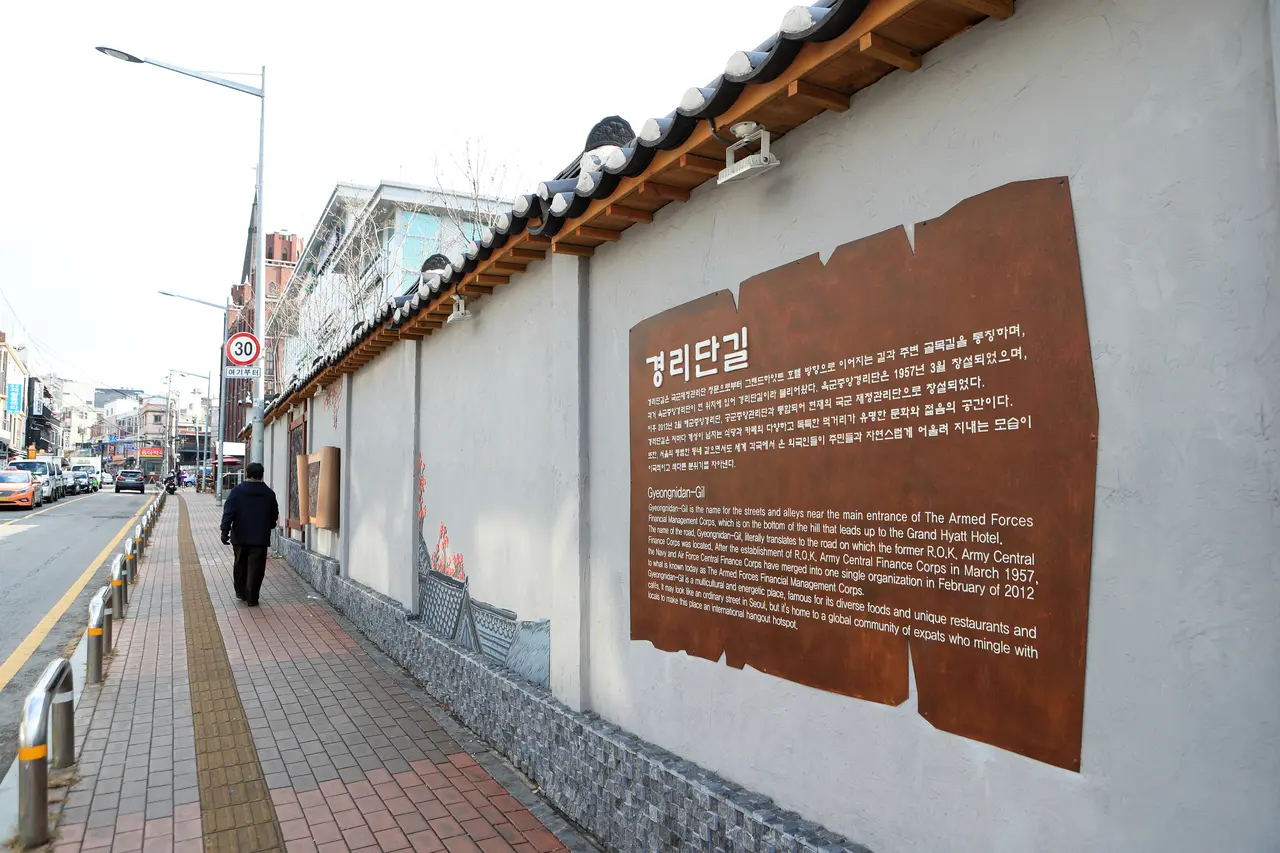
The first one is Gyeongnidan-gil in Itaewon-dong. It is named after the Army Central Finance Corps (yukgun jungang gyeongnidan) that was based at the bottom of the hill; that unit is now the Armed Forces Financial Management Corps. Korean newspapers began using the name around 2009, and the street was at its peak around 2013.
From about 2016 and 2017, people began giving the same ending to other neighborhoods that young people had started visiting, usually ones where rents were still low. The new names keep the second half of Gyeongnidan-gil and put the first syllable of the local neighborhood in front:
- Mangridan-gil: Mangwon-dong, in Mapo
- Songridan-gil: Songpa, by Seokchon Lake (the name was in use by late 2017)
- Yongridan-gil: Yongsan, between Sinyongsan and Samgakji stations
- Hwangnidan-gil: Hwangnam-dong in Gyeongju, outside Seoul (see Daereungwon and Hwangnidan-gil)
There are many more across the country, including Haengnidan-gil in Suwon and Gaengnidan-gil in Jeonju. A Korean business magazine wrote in 2018 that whenever a neighborhood takes off, it gets a “-ridan-gil” name “as if by agreement”, and by 2024 Seoul alone had more than ten of them.
Spelling. Under the official romanization the sound changes, so you will also see Mangnidan-gil, Yongnidan-gil and Songnidan-gil; Google Maps uses the “-nidan” spellings. This page uses the spellings on our cafe and food maps. Gyeongnidan-gil is already written in the official form here, though you may also see Gyeongridan-gil. Either spelling finds the same place on Google Maps, and the Korean name on each card works in any map app.
How a hot street rises and moves on
Gyeongnidan-gil is the case Korean media point to when a hot street cools. Crowds arrived, key money (a premium paid to the outgoing tenant) and rents shot up, and when the fashion cooled, shops closed and stayed empty. Koreans use the English word “gentrification” for this.
The numbers from Gyeongnidan-gil are stark. Of 39 restaurants on Yongsan-gu’s 2016 world food map of the street, 5 were still open in 2020. At the end of 2019 the vacancy rate for mid-sized and large shops in the Itaewon area was 26.4%, the highest of 45 commercial areas in Seoul, where the average was 8.0%. In a 2019 KB analysis, sales around Gyeongnidan-gil fell 13.7% in a year while sales around Ikseondong rose 27.3%: the crowd had moved.
The same worries followed the newer streets. On Songridan-gil, monthly rent for a 33 m² shop rose from 800,000 to 900,000 won to 1.3 to 1.5 million won within a year (reported in 2018), and on Mangridan-gil rents were reported at two to three times their earlier level by 2020.
Gyeongnidan-gil itself has partly come back. Interest returned to pre-pandemic levels by 2024, and the share of shops closing on the south side of the street fell from 5.9% in early 2019 to 1.7% in early 2024. For a visitor, the lesson is simple: a “-ridan-gil” name tells you a street was hot at some point, not that it is hot now. The streets below are the ones Seoul people go to today.
How Koreans find a hot place
A May 2026 survey of 1,060 Koreans in their twenties (Hankyung with the job platform Catch) asked how they find new places:
- Map apps come first. 55% discover hot places in a map app, 27% on social media and 2% through AI. 58% decide by searching a map app and going straight there; 23% see a place on social media or in a short video and then check it in a map app; 10% find a place through blog or online community reviews and then check it in a map app.
- Reviews before going. 57% check the reviews and star ratings in the map app before they visit.
- Naver Map is the main app. To get around, 62% use Naver Map, 24% KakaoMap and 8% Google Maps.
Naver Map lets people save places into lists and share them with friends; since December 2022 a shared list updates for everyone when the owner adds a place, and one account can save up to 5,000 places. Curated lists spread fast: in January 2026 a list of restaurants run by chefs from the cooking show Culinary Class Wars (season 2) had about 600,000 views and 100,000 saves. Naver Map also shows a nationwide “trend” ranking of the 20 most popular places in real time.
Seongsu adds pop-up stores to the mix: brands open short-term shops, and Seongdong-gu Office counted about 90 a month across Seongsu-dong (reported in 2024). Each pop-up decides its own entry, from a walk-in line to app booking.
What this means for you. Install Naver Map alongside Google Maps (see Map apps), and paste the Korean names from the cards on this page and on our maps into it. Shops on hot streets open and close often, so check a shop’s hours and recent reviews in the app on the day you go.
Choosing a street
- Korean brands and pop-ups: Yeonmujang-gil in Seongsu for flagship stores and pop-ups; the Hannam-dong cafe street for fashion and beauty showrooms in converted houses. Both are daytime streets.
- Hanok: Ikseondong, with outdoor bar tables (yajang) around Jongno 3-ga after dark.
- A park and small cafes: Yeontral Park, a short walk from Hongdae.
- Bakeries and a market: Mangridan-gil, next to Mangwon Market.
- Dinner and drinks: Yongridan-gil, best in the evening; the three restaurants on our food map here close on Sundays.
- With Lotte World Tower: Songridan-gil, by Seokchon Lake.
- The original: Gyeongnidan-gil, as part of an evening in Itaewon.
Cafes and restaurants on each street
The cards below are streets, not shops. For named cafes and restaurants with prices, hours and queue rules, use our two maps:
| Street | Neighborhood page | Cafes | Restaurants |
|---|---|---|---|
| Yeonmujang-gil | Seongsu | Seongsu cafes | Seongsu restaurants |
| Ikseondong | Insadong and Ikseondong | Anguk, Ikseondong and Bukchon cafes | Anguk, Ikseondong and Bukchon restaurants |
| Yeontral Park | Hongdae | Hongdae and Yeonnam cafes | Hongdae and Yeonnam restaurants |
| Mangridan-gil | Mangwon cafes | Mangwon restaurants | |
| Yongridan-gil | Yongridan-gil cafes | Yongridan-gil restaurants | |
| Songridan-gil | Lotte World Tower | Songridan-gil cafes | Songridan-gil restaurants |
| Hannam-dong and Gyeongnidan-gil | Itaewon and Hannam | Itaewon and Hannam cafes | Itaewon and Hannam restaurants |
Places by area
Seongsu
-
Yeonmujang-gil
Seongsu's main shopping street, where Korean brands open flagship stores and short-term pop-up stores. Seongdong-gu Office counted about 90 pop-ups a month across Seongsu-dong (reported in 2024), and shop rents depend heavily on whether a building is on Yeonmujang-gil or not. Seoul city figures put foreign visitors' card spending in Seongsu-dong from January to September 2026 at 263.8 billion won, double the year before.
- Hours
- Open at all times; most shops and pop-ups open around 11:00
- Nearest station
- Seongsu Station (Line 2), Exit 3, about 4 minutes on foot
- Pop-up entry
- Depends on the pop-up: a line on the street, advance booking (POPGA app, Naver Booking or the brand's own app) or a tablet waitlist at the door
Foreigner access
- Korean name
- 연무장길
- Booking
- Depends on the pop-up: walk-in line, POPGA app, Naver Booking, the brand's own app or a tablet waitlist on site
Korean phone number needed: Partly
Without a Korean number: Pick pop-ups with a walk-in line or an on-site tablet waitlist - Queue app
- POPGA (some pop-ups)
Some pop-ups take an on-site tablet waitlist; others only have a line.
Anguk, Ikseondong & Bukchon
-
Ikseondong Hanok Streets
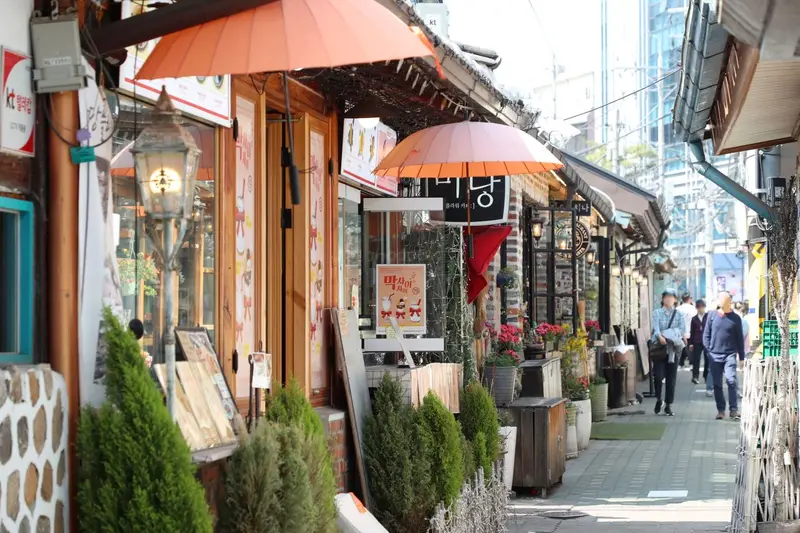
Narrow lanes of small city hanok (traditional houses) built in the 1920s by the developer Jeong Se-gwon, now full of cafes, restaurants and small shops. Seoul made it a hanok preservation district in 2018, which limits building height and keeps franchise shops out, so it is one of the few hot streets in Seoul made of hanok. In 2026 Time Out named Jongno 3-ga, including the Ikseondong lanes, the coolest neighborhood in the world.
- Hours
- Open at all times; each shop sets its own hours
- When to go
- Hanok cafes by day; lights come on under the eaves after dark. On weekend evenings the outdoor bar tables (yajang) by Jongno 3(sam)-ga Station Exits 4 and 5 fill up
- Nearest station
- Jongno 3(sam)-ga Station (Lines 1, 3, 5), Exit 4 or 6, about 2 minutes on foot
Foreigner access
- Korean name
- 익선동 한옥거리
Hongdae & Yeonnam
-
Yeontral Park (Gyeongui Line Forest Park)
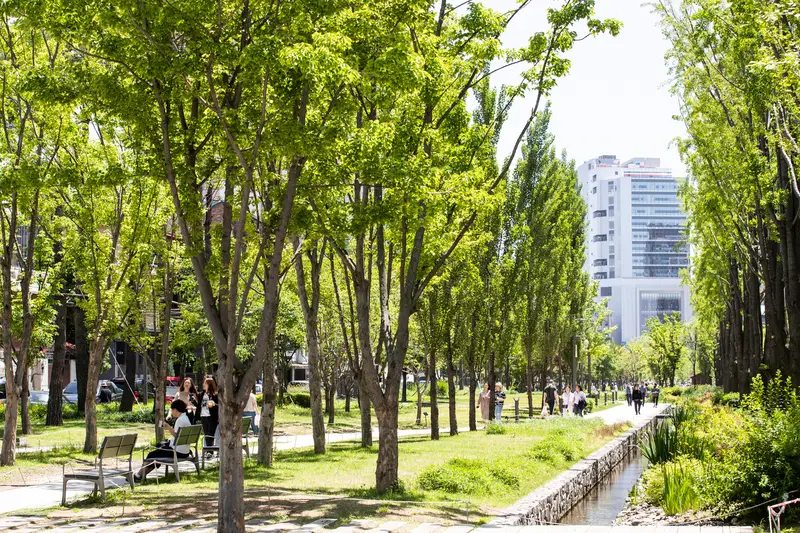
The Yeonnam-dong section of Gyeongui Line Forest Park, a long park built on a former railway line, about 1.2 km from Hongik Univ. Station to Yeonnam crossroads. Seoul's own articles call it Yeontral Park. Benches line a narrow stone-edged stream under the trees, and the side streets on both sides are lined with small cafes and restaurants.
- Hours
- Always open
- Admission
- Free
- Nearest station
- Hongik Univ. Station (Line 2, Gyeongui-Jungang Line, AREX), Exit 3, about 7 minutes on foot
Foreigner access
Google Maps for Yeontral Park (Gyeongui Line Forest Park) Naver Map for Yeontral Park (Gyeongui Line Forest Park)- Korean name
- 경의선숲길
Foreigner access details not yet confirmed
Mangwon
-
Mangridan-gil
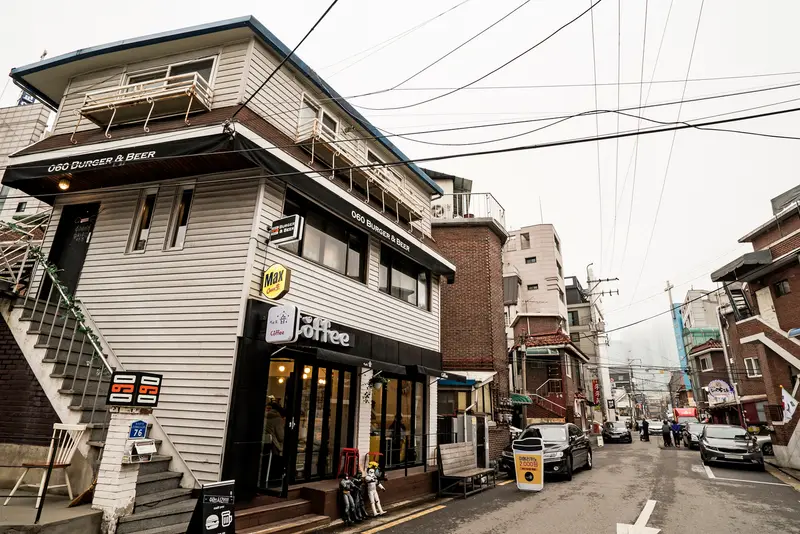
Mangridan-gil (also spelled Mangnidan-gil) joins Mangwon-dong and Gyeongnidan-gil: a low-rise residential area centered on Poeun-ro, the road from Mangwon Station Exit 2, near Mangwon Market. People come for the bakeries, cafes and small gift shops. On a weekday afternoon in late October 2026 about ten people were queuing at one bakery. Seoul approved redevelopment of the surrounding Mangwon 1 zone in October 2026, and the shops facing the Mangridan-gil road itself were left out of the plan.
- Hours
- Open at all times; each shop sets its own hours. Most cafes on our cafe map here open between 10:00 and 12:00, and one closes on Mondays
- When to go
- Weekends are busiest: stall holders at Mangwon Market say about half their weekend customers are visitors from elsewhere. A popular bakery can have a line even on a weekday
- Nearest station
- Mangwon Station (Line 6), Exit 2, about 8 minutes on foot
Yongridan-gil (Sinyongsan)
-
Yongridan-gil
The back streets between Sinyongsan and Samgakji stations (also spelled Yongnidan-gil). Old low-rise houses and shops sit beside new buildings, and the street now has izakaya-style bars, Italian restaurants, Korean beef grills and bars with DJs. A magazine called it "the so-called Yongridan-gil" as early as 2018, and in 2026 a Seoul newspaper described it as the street getting the most attention on social media. Yongsan-gu is redoing the streetscape and walkways here through the end of 2026.
- Hours
- Open at all times; each shop sets its own hours
- When to go
- Evenings, for dinner and drinks. The three restaurants on our food map here are all closed on Sundays
- Nearest station
- Samgakji Station (Lines 4, 6), Exit 3, about 4 minutes on foot, or Sinyongsan Station (Line 4), Exit 1, about 6 minutes
Songridan-gil (Seokchon Lake)
-
Songridan-gil
Songridan-gil (also spelled Songnidan-gil) joins Songpa and Gyeongnidan-gil: lanes running from the cafe street by the east lake of Seokchon Lake to Baekjegobun-ro, near Songpanaru Station. Lotte World Tower and Lotte World Mall opened on the north side of the lake in 2014, the area grew after that, and the street had its name by late 2017. Worth a walk on a day you visit Lotte World Tower; on its own it is a cafe stop rather than a reason to cross the city.
- Hours
- Open at all times; each shop sets its own hours. The cafes on our cafe map here open every day, between 10:00 and 12:00
- When to go
- An afternoon walk. Avoid the Seokchon Lake cherry blossom festival in early April unless you want crowds: the 2025 festival (April 2 to 13) counted about 8.62 million visits
- Nearest station
- Songpanaru Station (Line 9), Exit 1, about 5 minutes on foot, or Seokchon Station (Lines 8, 9), Exit 2, about 10 minutes
Itaewon & Hannam
-
Hannam-dong cafe street (Itaewon-ro 54-gil)
The cafe street of Hannam-dong, where low-rise houses have been rebuilt as showrooms for Korean fashion and beauty brands and as cafes. The wider Hannam shopping area also takes in the street Koreans call Comme des Garcons-gil, its best-known stretch with brand flagship stores, and the area around Hannam Ogeori (Five-way Intersection). In spring 2024, foreign visitors to Hannam were more than four times the number a year earlier, with Japanese visitors the largest group.
- Hours
- Shops open around 11:00 and close between 19:30 and 21:00
- When to go
- Daytime. Spending here peaks at lunchtime (11:00 to 15:00), and Saturdays take a large share of the week
- Nearest station
- Hangangjin Station (Line 6), Exit 3, about 6 minutes on foot
Foreigner access
Google Maps for Hannam-dong cafe street (Itaewon-ro 54-gil) Naver Map for Hannam-dong cafe street (Itaewon-ro 54-gil)- Korean name
- 이태원로54길
-
Gyeongnidan-gil
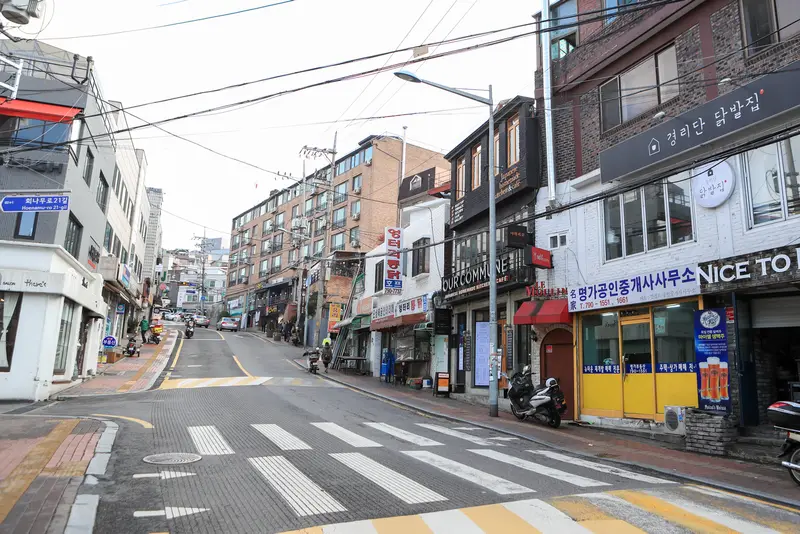
The street that started the "-ridan-gil" names: a hillside road from the gate of the Armed Forces Financial Management Corps toward the Grand Hyatt hotel, with small restaurants, cafes and bars in the lanes around it. After rents soared in the 2010s, Korean media held it up as the example of a hot street emptied by its own success; in the 2020s its shops have been filling up again. Come for the story and an evening in Itaewon rather than for the street alone.
- Hours
- Open at all times; each shop sets its own hours
- When to go
- Evenings, together with Itaewon or Haebangchon
- Nearest station
- Noksapyeong Station (Line 6), Exit 2, about 13 minutes on foot
Hotels
Experiences
Sources
- Etoday, "The children of Gyeongnidan-gil: its rise and fall" (2019-10-07, Korean) (accessed 2026-11-12)
- Business Hankook, gentrification on Songridan-gil (2018-12-14, Korean) (accessed 2026-11-12)
- Asia Economy, "The miracle of the O-ridan-gil?" (2024-08-24, Korean) (accessed 2026-11-12)
- Herald Economy, only 5 of 39 Gyeongnidan-gil restaurants left (2020-04-30, Korean) (accessed 2026-11-12)
- News Tomato, Gyeongnidan-gil and Ikseondong commercial analysis (2019-05-14, Korean) (accessed 2026-11-12)
- Dailian, Mangridan-gil report (2020-01-07, Korean) (accessed 2026-11-12)
- Kyunghyang Shinmun, Mangridan-gil and the Mangwon redevelopment (2026-11-01, Korean) (accessed 2026-11-12)
- Seoul Shinmun, Seoul Road: Yongridan-gil and Samgakji (2026-04-17, Korean) (accessed 2026-11-12)
- Seoul Shinmun, Seoul Road: Seokchon Lake and Songridan-gil (2026-04-03, Korean) (accessed 2026-11-12)
- Herald K, Yongsan-gu streetscape project for Yongridan-gil (2026-07-09, Korean) (accessed 2026-11-12)
- Allure Korea, Yongridan-gil between Sinyongsan and Samgakji (2018-08-12, Korean) (accessed 2026-11-12)
- Songpa-gu Office, Songridan-gil Gourmet Tour (English) (accessed 2026-11-12)
- News Tomato, pop-up stores in Seongsu-dong (2024-07-12, Korean) (accessed 2026-11-12)
- Seoul tourism and spending figures, reported by m-economynews (2026-11-05, Korean) (accessed 2026-11-12)
- Maeil Business, the Hannam-dong cafe street (2024-10-24, Korean) (accessed 2026-11-12)
- KB Think, commercial area analysis: Hannam-dong (2024-07-31, Korean) (accessed 2026-11-12)
- Seoul Metropolitan Government, Jongno 3-ga named the world's coolest neighborhood (2026-10-23, Korean) (accessed 2026-11-12)
- Seoul Metropolitan Government, Gyeongui Line Forest Park (2021-03-03, Korean) (accessed 2026-11-12)
- Hankyung, how people in their 20s find hot places (2026-05-07, Korean) (accessed 2026-11-12)
- Segye Ilbo, Naver Map Save tab (2022-12-17, Korean) (accessed 2026-11-12)
- Digital Times, map apps as a trend channel (2026-01-20, Korean) (accessed 2026-11-12)
- Naver Map: 용리단길, 송리단길, 망리단길, 경리단길, 연무장길, 익선동한옥거리, 이태원로54길, 경의선숲길 (stations and walking times; Korean) (accessed 2026-11-12)