Cherry Blossoms in Seoul
When the trees bloom, the two big festivals, stream walks, palaces and quieter spots, with stations and 2026 dates
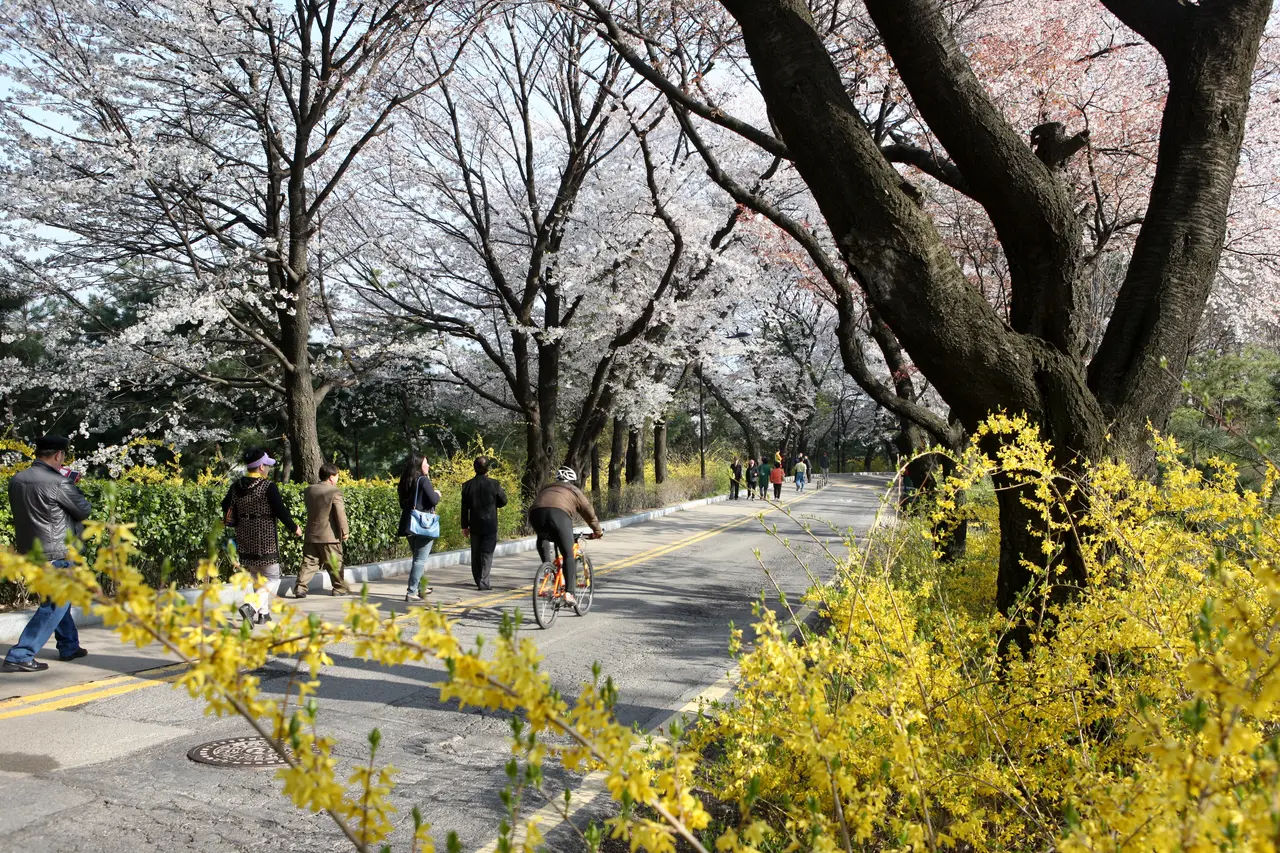
Seoul's cherry trees bloom for a short spell each spring, in recent years from the end of March into the first half of April. This page covers the 14 places Seoul people go to most, from the festival roads at Yeouido and Seokchon Lake to stream-side paths, palace gardens and a campus, with the nearest station, last year's festival dates and which spots are lit at night.
Intro
Around the start of April the cherry trees along Seoul’s roads, streams and palace walls come into flower, and full bloom follows the first flowers by about a week. The two best-known places are the road behind the National Assembly on Yeouido and the lake path below Lotte World Tower at Seokchon Lake, each with a district festival in early April and millions of visitors. The other places on this page are smaller: stream paths with their own district festivals, palaces, a park with a zoo, a library garden, a university campus and a cemetery known for its weeping cherries. This page gives the nearest station, hours and last year’s festival dates for each, and a plan for one blossom day.
When do the cherry blossoms bloom in Seoul?
Plan for late March to mid-April, and check the forecast in March.
The Korea Meteorological Administration (KMA) records the official date from a standard king cherry tree at its Seoul observatory in Jongno, and counts the trees as open when one branch has at least three flowers fully out. Seoul’s first blossoms came on April 1 in 2024, April 4 in 2025 and March 29 in 2026. The 1991 to 2020 normal is April 8 for first bloom and April 10 for full bloom, and full bloom usually follows about a week after the first flowers. Recent years have been early: the trees opened in March in 2014, 2020, 2021, 2023 and 2026.
2027 forecast: not out yet. Forecasts come from the Korea Forest Service, which publishes a spring flowering forecast map in late February (February 24 in 2026), and from private weather companies, which publish theirs in March. They can be several days out. In 2026 a private forecast put Seoul’s first bloom on April 3, and the trees opened on March 29.
Blossom status in spring: the KMA’s weather site shows each observation as it happens, under its spring flowers page (봄꽃개화현황).
What else flowers around the same time:
- Forsythia and azaleas open in late March, just before the cherry trees. Eungbongsan is the yellow forsythia hill.
- Double-flowered cherries open in mid to late April, after the king cherries have fallen. Children’s Grand Park and Jeongdok Library are two places to see them, so they are worth knowing about if your trip is late.
The 14 places at a glance
| Place | Go for | Nearest station |
|---|---|---|
| Yeouido (Yeouiseo-ro) | 1.7 km road closed to cars, the spring flower festival | National Assembly (Line 9) |
| Seokchon Lake | 2.5 km lake path under Lotte World Tower, lit at night | Jamsil (Lines 2, 8) |
| Namsan | Cherry tunnel on the road to N Seoul Tower | Chungmuro (Lines 3, 4), then bus |
| Seoul Forest | Blossoms by the deer enclosure, then Seongsu | Seoul-forest (Suin-Bundang) |
| Eungbongsan | A hill covered in forsythia, late March | Eungbong (Gyeongui-Jungang) |
| Children’s Grand Park | Blossoms with a free zoo, for families | Children’s Grand Park (Line 7) |
| Yangjaecheon | Three weeks of evening lanterns by a stream | Yangjae Citizen’s Forest (Sinbundang) |
| Anyangcheon | A long embankment walk you can join from several stations | Yangpyeong (Line 5) |
| Bulgwangcheon | A stream walk with Bukhansan behind | Eungam (Line 6) |
| Changgyeonggung | Palace blossoms until 21:00 | Hyehwa (Line 4) |
| Gyeongbokgung | Blossoms by Gyeonghoeru, in hanbok | Gyeongbokgung (Line 3) |
| Jeongdok Library | A library garden in Bukchon | Anguk (Line 3) |
| Kyung Hee University | Blossoms with stone and Gothic buildings | Hoegi (Line 1), then bus |
| Seoul National Cemetery | Weeping cherries, daytime only | Dongjak (Lines 4, 9) |
Festivals and road closures
The festivals follow the bloom, so their dates move every year. The district offices usually announce them in late March, once the bloom date is clearer. The table gives last year’s (2026) dates so you know what to expect.
| Festival | Usually | Last year (2026) | Worth knowing |
|---|---|---|---|
| Eungbongsan Forsythia Festival | Late March, two days | March 27 and 28 | Roads up the hill closed to cars |
| Yangjaecheon Cherry Blossom Lantern Festival | Late March to mid-April | March 30 to April 19 | Path lit in the evening |
| Yeongdeungpo Yeouido Spring Flower Festival | Early April | April 3 to 7 | Yeouiseo-ro closed to cars April 1 (12:00) to April 8 (14:00) |
| Seokchon Lake Cherry Blossom Festival | Early April | April 3 to 11 | Whole lake path lit; pink lights from March 27 |
| Eunpyeong-ui Bom (Bulgwangcheon) | Early April, two days | April 3 and 4 | Evening concert |
In 2026 Yeouido moved its festival five days earlier than first planned when the trees opened early, so check the district’s notice in the week before you go.
Blossoms at night
- Seokchon Lake is the one to pick for night blossoms. In 2026 the whole 2.5 km path was lit, from a week before the festival to its end.
- Yeouido: in 2026 the festival programs ran until 21:30, with a DJ party and outdoor films in the evening.
- Yangjaecheon: the lantern festival lights the stream path in the evening for its three weeks.
- Changgyeonggung is open until 21:00 all year, with Chundangji pond and the glasshouse in the area open in the evening. It is the palace for blossoms after dark; Gyeongbokgung’s night openings in 2026 did not start until mid-May. See Seoul at Night for Deoksugung, which also stays open until 21:00.
- Seoul National Cemetery closes at 18:00.
Crowds
The two festival spots are very busy at full bloom. Yeongdeungpo District counted 3.6 million visitors over the five days of the 2026 Yeouido festival, and Songpa District counted 9.01 million visits to Seokchon Lake and the shops around it over 17 days, 260,000 of them by foreign visitors. The busiest days are weekends that fall at full bloom. If you can, go to these two on a weekday, and keep the weekend for one of the smaller places on this page.
A blossom day in Seoul
A plan for one day at full bloom, by subway:
- Morning, Gyeongbokgung (opens 9:00, closed Tuesdays): blossoms around Gyeonghoeru. Rent hanbok near the palace and you enter free; see Hanbok rental.
- Late morning, Jeongdok Library and Bukchon: walk east from the palace to the library garden, then through the hanok lanes of Bukchon (the core lanes are open to tourists from 10:00 to 17:00).
- Afternoon, Yeouido: subway to National Assembly Station and walk the 1.7 km road; on festival days it is closed to cars. The Han River park is next to it (Hangang Parks).
- Evening, Seokchon Lake or Changgyeonggung: the lit lake path under Lotte World Tower, or the palace until 21:00 if you would rather stay central.
If you are in Seoul in late March, before the cherry trees open, go to Eungbongsan for the forsythia, then on to Seoul Forest and the cafes of Seongsu.
Other places Seoul people go
- Boramae Park in Dongjak District is known for weeping cherries, in full bloom around April 1 in 2026, and Dream Forest in the north of the city flowered from about April 1 to 8 in 2026. Both are on the Big Parks page.
- Deoksugung: cherry trees line the path inside Daehanmun, the main gate. See Deoksugung Palace.
- Dorimcheon: the stream that joins Anyangcheon, with cherry trees right outside Exit 2 of Dorimcheon Station (Line 2 branch).
- Gyeongui Line Forest Park: the park on an old railway line, from Exit 6 of Hongik Univ. Station toward Daeheung, has cherry trees along it.
- Jungnangcheon in northeast Seoul and Seongnaecheon in Songpa are two more stream paths on Korean blossom lists.
- Seoul Grand Park in Gwacheon, just outside Seoul, also comes up often on Korean lists; it is at Seoul Grand Park Station on Line 4.
Questions travelers ask
When is cherry blossom season in Seoul? Plan for late March to mid-April. Seoul’s first blossoms were on April 1 in 2024, April 4 in 2025 and March 29 in 2026, and full bloom usually comes about a week after the first flowers.
Is there a 2027 cherry blossom forecast for Seoul? Not yet. The Korea Forest Service usually publishes its forecast map in late February and private forecasters theirs in March. Check the forecast in March and keep a few days of slack in your plans.
When is the Yeouido cherry blossom festival in 2027? Not announced yet. It is usually in early April and the dates are announced in late March. Last year (2026) it ran from April 3 to 7.
How do I know if the blossoms are out now? Check the KMA’s spring flower observations (봄꽃개화현황) on its weather site, which posts each observation as it is made.
Are the cherry blossoms at Seokchon Lake lit up at night? Last year (2026) the whole 2.5 km lake path was lit, starting with pink lights on March 27, a week before the festival.
Are there cherry blossoms in Seoul Forest? Yes. They usually bloom in early April, around the deer enclosure, and the tulips follow from mid to late April.
Do I need a ticket or a Korean phone number? No. The roads, parks and streams are free and open; the palaces sell tickets at the gate.
See also
- Korea Weather by Month and When to Go: April weather, yellow dust and cherry blossoms elsewhere in Korea.
- Yeouido, Jamsil and Seokchon Lake, N Seoul Tower and Namsan and Seoul Forest for the rest of each area.
- Seoul’s Big Parks and Hangang Parks for a picnic in spring.
For more of the city, see the Seoul guide.
Hours & Fees
- When to plan for
- Late March to mid-April. Seoul's first blossoms were recorded on April 1 in 2024, April 4 in 2025 and March 29 in 2026, and full bloom usually follows within about a week. Check the forecast in March
- 2027 festivals
- Usually early April; dates are announced in late March. The dates on this page are last year's (2026)
- Admission
- The festival roads, stream paths and Namsan are open at all times and free. Palaces charge admission; hours for each place are on its card
Places by area
The two festival spots
-
Yeouiseo-ro Cherry Blossom Road (Yunjung-ro), Yeouido
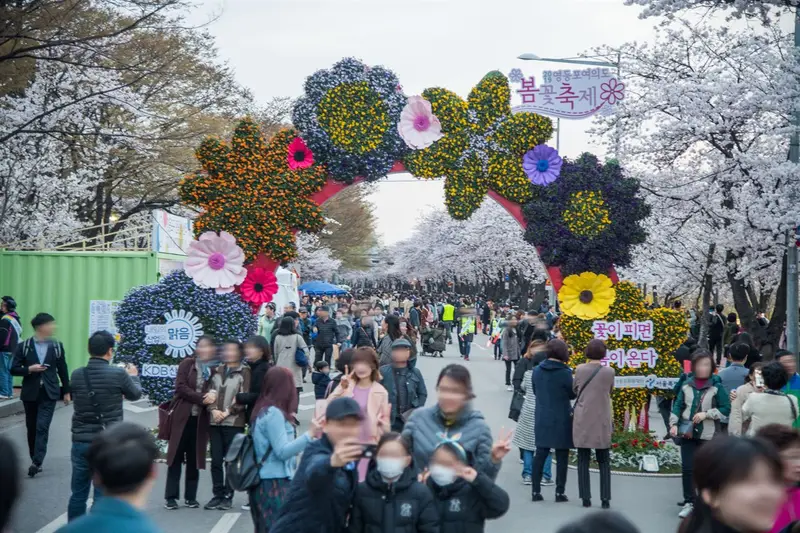
One of Seoul's best-known cherry blossom roads, it runs 1.7 km along Yeouiseo-ro behind the National Assembly, from the south end of Seogang Bridge to Gate 3 of the National Assembly. About 1,886 cherry trees stand among some 80,000 spring flowering plants of 13 kinds. Every April since 2005 the Yeongdeungpo Yeouido Spring Flower Festival has been held here, and the road is closed to cars and becomes a walking street. The Korea Meteorological Administration has kept a separate bloom record for three marked trees here since 2000: they flowered on March 29 in 2026, the same day as the city's official tree, and their normal date is April 6, two days earlier than the city's. Yeongdeungpo District counted 3.6 million visitors over the five days of the 2026 festival, 19 percent more than the year before.
- Festival
- Last year (2026): April 3 to 7, programs 11:30 to 21:30, free, with an opening parade and food stalls. 2027: usually early April; dates are announced in late March
- Road closure
- Last year (2026): from April 1 at 12:00 to April 8 at 14:00, Yeouiseo-ro and the riverside road from the south end of Seogang Bridge to the Yeouiharyu interchange were closed to cars. Kick scooters and bicycles were not allowed in the festival area
- Hours
- The road is open at all times. Free
- Nearest station
- National Assembly Station (Line 9), Exit 1, about 3 minutes to the start of the blossom road, or Yeouinaru Station (Line 5), Exit 1
Foreigner access
Google Maps for Yeouiseo-ro Cherry Blossom Road (Yunjung-ro), Yeouido Naver Map for Yeouiseo-ro Cherry Blossom Road (Yunjung-ro), Yeouido- Korean name
- 여의서로 벚꽃길
-
Seokchon Lake
A lake park at the foot of Lotte World Tower, with a path of about 2.5 km around its east and west lakes and about 1,000 king cherry trees forming a tunnel over it. Songpa District's Lake Cherry Blossom Festival is held here in early April; in 2026 the district made it nine days instead of five, because the bloom is hard to predict, and lit the whole path at night, starting with pink lights from March 27. Over those 17 days, from the first lights to the end of the festival, the district counted 9.01 million visits to the lake, the shops around it and Lotte World Mall, from mobile phone data, including 260,000 by foreign visitors. Expect very full paths on weekends at full bloom.
- Festival
- Last year (2026): April 3 to 11, 10:00 to 21:00. Performances free; the flea market, food trucks and hands-on activities cost extra. 2027: usually early April; dates are announced in late March
- Night lights
- Last year (2026): the whole 2.5 km path was lit, with a blossom gate at the lake entrance
- Hours
- Open 24 hours, every day. Free
- Nearest station
- Jamsil Station (Lines 2 and 8), Exit 3, about 8 minutes. Seokchon-gobun Station (Line 9), Exit 2, about 560 m. Songpanaru Station (Line 9), Exit 1, for the Songridan-gil side
Parks and hills
-
Namsan Park circular roads
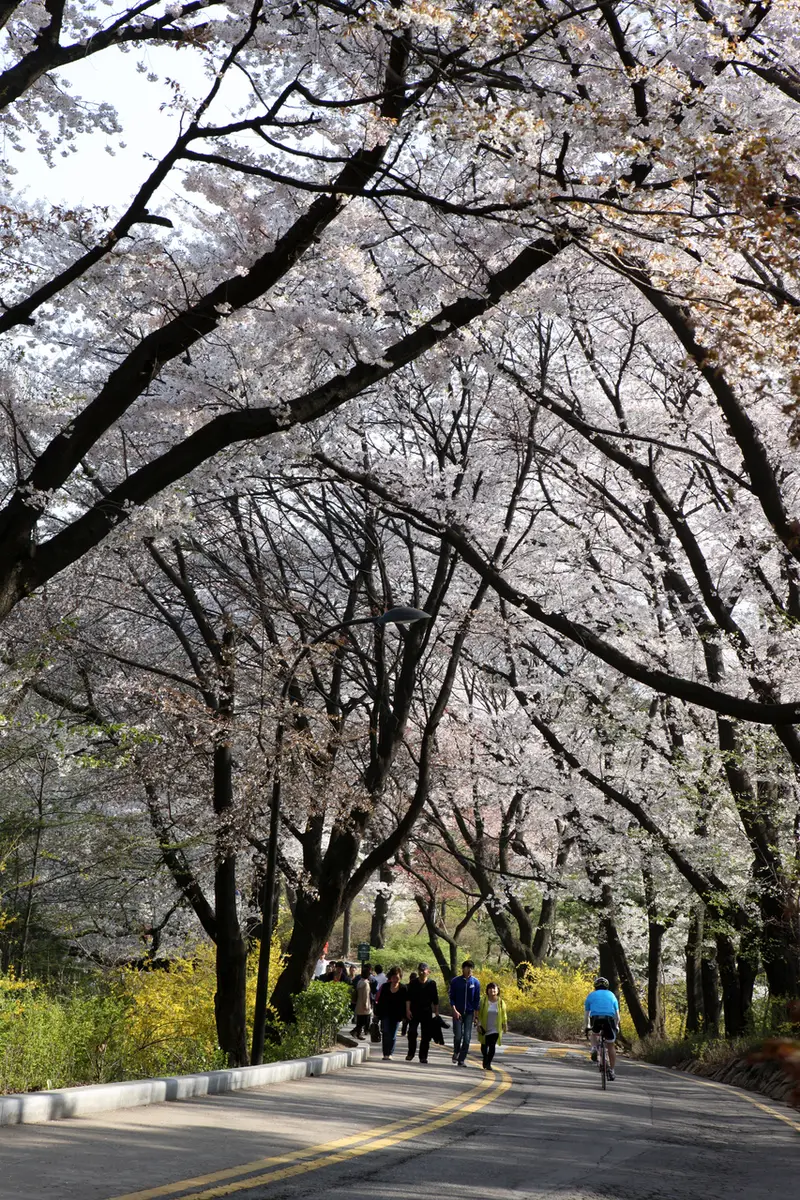
The hill in the middle of Seoul has two cherry blossom roads, both closed to ordinary cars and taxis since 2005: the South Circular Road, from the National Theater of Korea past N Seoul Tower to Namsan Library, where the king cherries form a tunnel, and the North Circular Road, from the National Theater past Seokhojeong to Hoehyeon-dong. Seoul lists Namsan Park among its spring flower routes. There is no festival and no fee: walk up, or ride a circular bus to one end of a road and walk the rest. In 2026 Seoul's blossoms opened on March 29, ten days earlier than usual; the peak on Namsan itself has not been confirmed.
- Hours
- Open at all times. Free
- Getting there
- Circular buses 01A and 01B from Chungmuro Station (Exit 2) or Dongguk University Station (Exit 6) stop at the National Theater of Korea and at Namsan Library, the two ends of the South Circular Road. Transit card only. Buses 402 and 405 also stop at Namsan Library
Foreigner access
- Korean name
- 남산공원
-
Seoul Forest
A big free park next to Seongsu. The cherry trees usually bloom in early April, around the sika deer enclosure in the Eco Forest and near the hill called Baram-ui Eondeok, and the tulips usually follow from mid to late April. There is no festival. Feeding the deer is not allowed. Pair it with the cafes and shops of Seongsu, next door.
- Hours
- Open at all times; some facilities inside keep their own hours. Free
- Nearest station
- Seoul-forest Station (Suin-Bundang Line), Exit 4, about 2 minutes. Ttukseom Station (Line 2), Exit 8, about 10 minutes
-
Eungbongsan (forsythia)
Not cherry blossoms but forsythia, and earlier: in late March this low hill on the north bank of the Han River, under 100 m, turns yellow with about 200,000 forsythia bushes before most of the city's cherry trees open. From the eight-sided pavilion at the top you look over the river and Seoul Forest. Seongdong District holds a two-day forsythia festival around the pavilion at the end of March, with performances and photo spots. It is one of the most popular spots on Seoul's list of 175 spring flower routes, according to a Seoul city citizen reporter (2026). The way up has steps and slopes, so wear sneakers.
- Festival
- Last year (2026): March 27 and 28. Cars were not allowed on the roads up the hill during the festival. 2027 dates not announced
- Hours
- Open at all times. Free
- Nearest station
- Eungbong Station (Gyeongui-Jungang Line), from the Exit 1 side, 15 to 20 minutes on foot and uphill
Foreigner access
- Korean name
- 응봉산 팔각정
-
Seoul Children's Grand Park
A free park in east Seoul with a free zoo, right at a subway exit. Cherry trees line the broad road in from the main gate, and the park is also known for double-flowered cherries, which open in mid to late April after the others have fallen. A good blossom outing with children, since the zoo, playgrounds and Seoul Children's Museum are in the same park.
- Hours
- Park 5:00 to 22:00, every day. Zoo 10:00 to 17:00
- Admission
- Free (park and zoo)
- Nearest station
- Children's Grand Park Station (Line 7), Exit 1, for the main gate. Achasan Station (Line 5), Exit 4, for the back gate
Foreigner access
- Korean name
- 서울어린이대공원
Along the streams
-
Yangjaecheon Stream
A stream in Seocho District, south of the river, with cherry trees along the path on its banks. The festival stretch runs between the Yeongdong 1-gyo and Yeongdong 2-gyo bridges and joins up with Maeheon Citizen's Forest. Seocho Cultural Center's Yangjaecheon Cherry Blossom Lantern Festival lasts about three weeks and lights the path in the evening as a "spring light walk": the eighth edition ran from March 30 to April 19, 2026, with stage events on April 3 to 5. The Yangjaecheon cafe street is by the station end.
- Festival
- Last year (2026): March 30 to April 19, events 13:00 to 20:00, free; opening and lighting ceremony on April 3 at 18:30 at the waterside stage. 2027: dates are announced in late March
- Hours
- The stream path is open at all times. Free
- Nearest station
- Yangjae Citizen's Forest Station (Sinbundang Line), Exit 2, about 2 minutes to the start of the cafe street, across from the waterside stage
Foreigner access
- Korean name
- 양재천 벚꽃길
-
Anyangcheon embankment
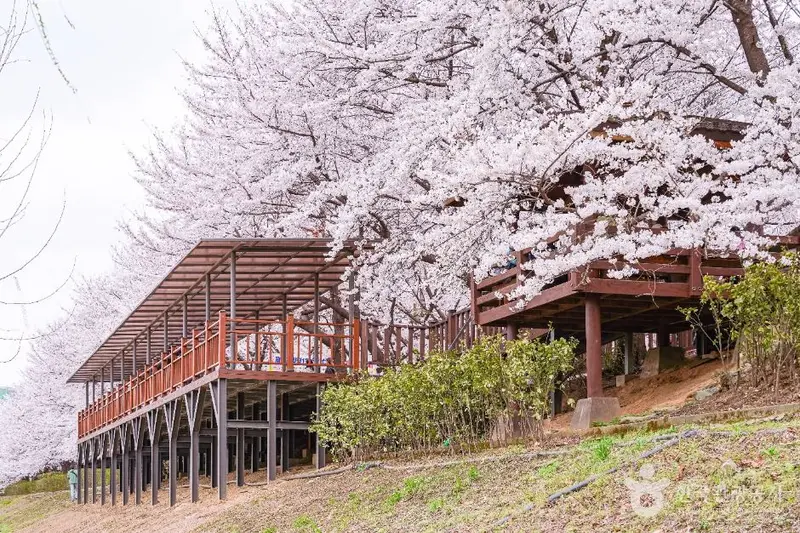
The Korea Tourism Organization calls the cherry road on top of the Anyangcheon embankment, which runs from Yeongdeungpo District south to Gwangmyeong, the longest in Seoul. Several districts share it: Guro District counts about 800 king cherries on its Anyangcheon and Dorimcheon banks, and Geumcheon District counted 1,047 along its 7 km stretch in 2024. Because it is long and has stations along the way, you can join it where you like and walk as far as you want. The districts hold small events of their own, such as Yeongdeungpo's spring flower festival on the bank around April 4 and a cherry blossom run on April 11 in 2026.
- Hours
- Open at all times. Free
- Nearest station
- Yangpyeong Station (Line 5), Exit 1, for the Yeongdeungpo bank. Dorimcheon Station (Line 2 branch), Exit 2, or Guil Station (Line 1), Exit 1, further south
Foreigner access
- Korean name
- 안양천 제방 벚꽃길
-
Bulgwangcheon Stream
A 9.21 km stream from Eunpyeong District down to Mapo District in northwest Seoul, with a walking path and a bike path along its banks. The blossom path starts right outside Eungam and Saejeol stations, and on a clear day you can photograph the trees with Bukhansan behind. Eunpyeong District's two-day spring festival, Eunpyeong-ui Bom, is held on the banks in early April: in 2026 it ran on April 3 and 4, with an evening concert on April 4 by Dynamic Duo, Roy Kim and Jang Yoon-jeong. A cherry blossom marathon ran along the stream on March 29, 2026.
- Festival
- Last year (2026): April 3 and 4. 2027: usually early April; dates are announced in late March
- Hours
- Open at all times. Free
- Nearest station
- Eungam Station (Line 6), Exit 4, or Saejeol Station (Line 6). Jeungsan Station (Line 6), Exit 2, for the lower stretch
Foreigner access
- Korean name
- 불광천
Palaces, a campus, a library and a cemetery
-
Changgyeonggung Palace
In the Japanese colonial period this palace was turned into a zoo and botanical garden called Changgyeongwon, and from 1922 thousands of cherry trees were planted there; it became the city's place for viewing blossoms at night. Today cherry, Nanking cherry and plum trees flower inside Honghwamun, the main gate, and weeping cherries hang over Chundangji pond. It is open until 21:00 all year with no booking, so it is the easiest palace for blossoms after dark; the area open in the evening includes Honghwamun, Myeongjeongjeon Hall, Chundangji and the glasshouse (Daeonsil).
- Hours
- 9:00 to 21:00 all year (last entry 20:00). Closed Mondays
- Admission
- 1,000 won for foreign visitors aged 19 to 64, a separate ticket from Changdeokgung. Buy at the gate
- Nearest station
- Hyehwa Station (Line 4), Exit 4, about 13 minutes on foot
Foreigner access
- Korean name
- 창경궁
- Booking
- No booking; buy a ticket at the gate
- English
- Staff: unconfirmed
-
Gyeongbokgung Palace
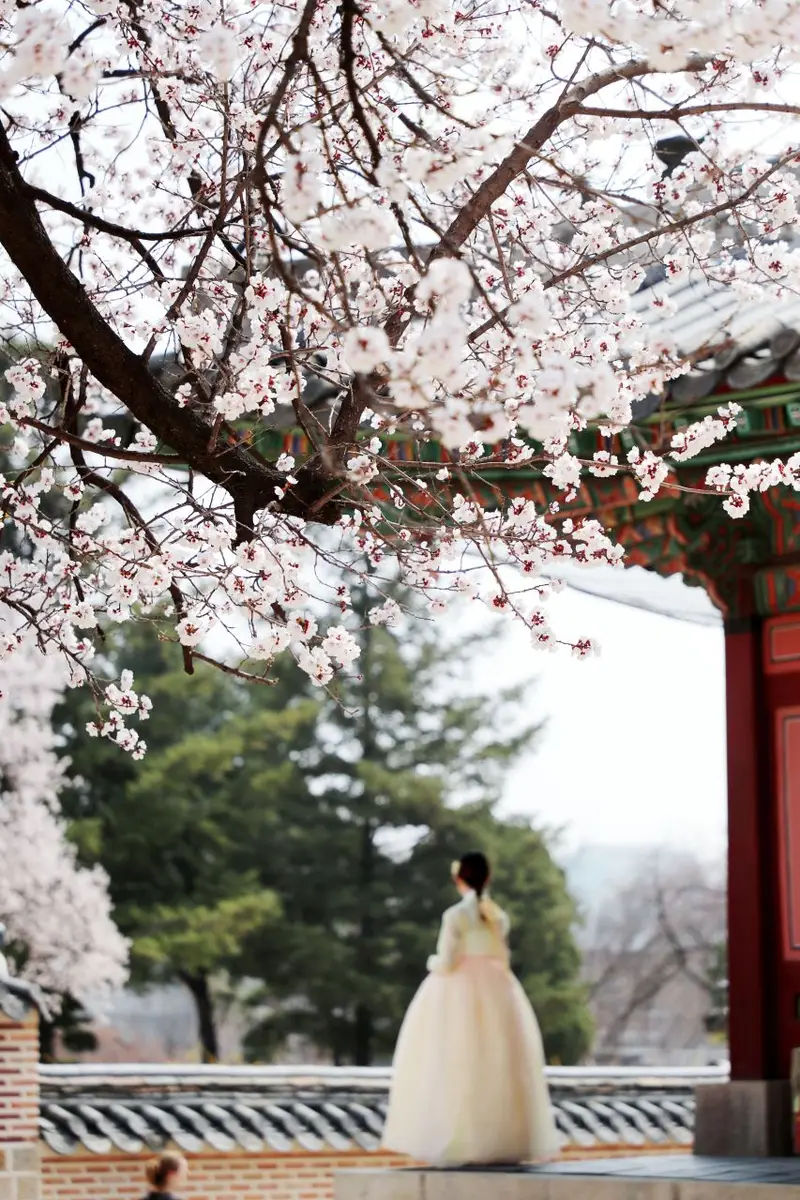
Cherry trees stand around Gyeonghoeru, the pavilion on its pond northwest of the throne hall. Yeongchumun, the west gate, is the closest gate to the pond, and many Korean visitors come in that way in blossom season. Gyeongbokgung is a daytime visit in spring: its night openings in 2026 started in mid-May, after the blossoms. Visitors in hanbok that meets the palace guidelines enter free.
- Hours
- March to May: 9:00 to 18:00 (last entry 17:00). Closed Tuesdays
- Admission
- 3,000 won for foreign visitors aged 19 to 64. Free for ages 18 and under, 65 and over, and anyone in hanbok that meets the palace guidelines
- Nearest station
- Gyeongbokgung Station (Line 3), Exit 5
Foreigner access
- Korean name
- 경복궁
- Booking
- No booking for daytime visits; buy a ticket on the day
- English
- Staff: unconfirmed
-
Jeongdok Public Library
A public library between Bukchon and Samcheong-dong, on the former site of a high school, with a large garden. A tunnel of cherry trees runs to the left of the entrance sign, there are weeping cherries behind the main building and more trees around a small pond, and later in April it is also known for double-flowered cherries. It is a short walk from the Bukchon hanok lanes, so combine the two. Parking is limited and free only for library users, so come by subway.
- Garden hours
- unconfirmed
- Nearest station
- Anguk Station (Line 3), Exit 3, about 5 minutes on foot
Foreigner access
- Korean name
- 정독도서관
Foreigner access details not yet confirmed
-
Kyung Hee University Seoul Campus
A university campus in northeast Seoul known for its buildings: the stone-columned Main Building in a neoclassical style and the Gothic-style Grand Peace Hall. Large cherry trees line the road from the main gate up to them, and more stand around the small pond behind the Main Building. It is a working university: stay outside the buildings.
- Campus hours
- unconfirmed
- Getting there
- Hoegi Station (Line 1 and Gyeongui-Jungang Line), Exit 1, then village bus Dongdaemun 01 to the main gate
Foreigner access
- Korean name
- 경희대학교 서울캠퍼스
-
Seoul National Cemetery
Korea's national cemetery, founded as a military cemetery in 1955, is known in spring for its weeping cherry trees, planted in the 1960s and 1970s, along the road from the fountain at the main gate and around Hyeonchungji pond. It is a place of remembrance with graves, so walk quietly; it is not a picnic spot. The gates close at 18:00, so there is no evening viewing.
- Hours
- Main gate 6:00 to 18:00, every day of the year
- Admission
- Free
- Nearest station
- Dongjak Station (Lines 4 and 9), Exit 8, for the main gate
Foreigner access
- Korean name
- 국립서울현충원
Hotels
Experiences
Sources
- Korea Meteorological Administration: Seoul cherry blossoms first bloom, 2025, with the 2024 date, normal dates, Yunjung-ro observation and bloom definitions (Korean) (accessed 2026-11-14)
- Herald Business: Seoul cherry blossoms open March 29, 2026, fifth earliest on record, Yunjung-ro the same day (April 5, 2026, Korean) (accessed 2026-11-14)
- SisaIN: Seoul's first blossoms and 102 years of records (May 9, 2026, Korean) (accessed 2026-11-14)
- Gukje News: KMA declares Seoul cherry blossoms open, normal full bloom April 10 (March 30, 2026, Korean) (accessed 2026-11-14)
- Kyunghyang Shinmun: cherry blossom forecasts, full bloom about a week after first bloom (March 25, 2026, Korean) (accessed 2026-11-14)
- News Seoul: Korea Forest Service 2026 spring flowering forecast map (February 24, 2026, Korean) (accessed 2026-11-14)
- Hankyung Magazine: Seoul blossoms five days earlier than the private forecast, Seokchon festival lengthened (April 2, 2026, Korean) (accessed 2026-11-14)
- Newspim: Seoul's 175 spring flower routes, forsythia and azaleas in late March (March 27, 2026, Korean) (accessed 2026-11-14)
- Chosun Ilbo: double-flowered cherries at Jeongdok Library and Children's Grand Park (April 30, 2024, Korean) (accessed 2026-11-14)
- FT Sports: double-flowered cherries in late April, Children's Grand Park (April 7, 2026, Korean) (accessed 2026-11-14)
- Korea Tourism Organization (TourAPI): Yeongdeungpo Yeouido Spring Flower Festival 2026 (Korean) (accessed 2026-11-14)
- Korea Tourism Organization (TourAPI): Songpa Lake Cherry Blossom Festival 2026 (Korean) (accessed 2026-11-14)
- Korea Tourism Organization (TourAPI): 8th Yangjaecheon Cherry Blossom Lantern Festival 2026 (Korean) (accessed 2026-11-14)
- Korea Tourism Organization (TourAPI): Anyangcheon embankment cherry blossom road (Korean) (accessed 2026-11-14)
- Korea Tourism Organization (TourAPI): Seokchon Lake (Korean) (accessed 2026-11-14)
- Korea Tourism Organization (TourAPI): Seoul Forest (Korean) (accessed 2026-11-14)
- Korea Tourism Organization (TourAPI): Namsan Park, no private cars or taxis since 2005 (Korean) (accessed 2026-11-14)
- Korea Tourism Organization (TourAPI): Yangjaecheon park (Korean) (accessed 2026-11-14)
- Korea Tourism Organization (TourAPI): Bulgwangcheon (Korean) (accessed 2026-11-14)
- Korea Tourism Organization (TourAPI): Seoul National Cemetery (Korean) (accessed 2026-11-14)
- Korea Tourism Organization (TourAPI): Seoul Children's Grand Park, park and zoo hours (Korean) (accessed 2026-11-14)
- Ministry of Patriots and Veterans Affairs: Seoul National Cemetery opening hours (Korean) (accessed 2026-11-14)
- Seoul Metropolitan Government Mediahub: Eungbongsan or Namsan Park, forsythia festival and directions (April 1, 2026, Korean) (accessed 2026-11-14)
- Seoul Metropolitan Government Mediahub: spring flowers in Seoul's four palaces, Changgyeonggung hours and directions (2023, Korean) (accessed 2026-11-14)
- Royal Palaces and Tombs Center: viewing hours and closing days (Korean) (accessed 2026-11-14)
- Royal Palaces and Tombs Center: admission fees, Changgyeonggung (Korean) (accessed 2026-11-14)
- Royal Palaces and Tombs Center: Gyeongbokgung admission fees and passes (Korean) (accessed 2026-11-14)
- Royal Palaces and Tombs Center: free admission in hanbok, guidelines (Korean) (accessed 2026-11-14)
- Notice: Gyeongbokgung night viewing, first half of 2026 (Korean) (accessed 2026-11-14)
- Lecturer News: Seoul spring park festival, Namsan South and North Circular Road cherry routes (March 28, 2023, Korean) (accessed 2026-11-14)
- News Tomato: king cherry tunnel on Namsan South Circular Road (April 13, 2017, Korean) (accessed 2026-11-14)
- Rapportian: Yeouido Spring Flower Festival April 3 to 7, 2026, road closures (March 30, 2026, Korean) (accessed 2026-11-14)
- Maeil Business: Yeouido festival opened five days early, hours extended to 21:30 (April 4, 2026, Korean) (accessed 2026-11-14)
- Munhwa Ilbo: 3.6 million visitors at the 2026 Yeouido Spring Flower Festival, Anyangcheon spring flower festival (April 10, 2026, Korean) (accessed 2026-11-14)
- Yonhap News: Seokchon Lake Cherry Blossom Festival April 3 to 11, 2026, lights on the whole 2.5 km path (March 25, 2026, Korean) (accessed 2026-11-14)
- Dong-A Ilbo: Seokchon Lake lights, Yeouido until 21:30, Guro Anyangcheon and Dorimcheon cherry trees (March 25, 2026, Korean) (accessed 2026-11-14)
- Seoul Shinmun: 9.01 million visits to Seokchon Lake over 17 days, 260,000 foreign visitors (April 30, 2026, Korean) (accessed 2026-11-14)
- Aju Business Daily: 8th Yangjaecheon Cherry Blossom Lantern Festival (March 24, 2026, Korean) (accessed 2026-11-14)
- eNews Today: Yangjaecheon festival March 30 to April 19, evening lights (March 30, 2026, Korean) (accessed 2026-11-14)
- Asia Today: Geumcheon District Anyangcheon king cherries (April 4, 2024, Korean) (accessed 2026-11-14)
- Popcorn News: Anyangcheon cherry blossom run, April 11, 2026 (Korean) (accessed 2026-11-14)
- CNB: Eunpyeong-ui Bom festival on Bulgwangcheon, April 3 and 4, 2026 (March 19, 2026, Korean) (accessed 2026-11-14)
- Yonhap News: Bulgwangcheon cherry blossom marathon, March 29, 2026 (February 27, 2026, Korean) (accessed 2026-11-14)
- MHN: Eungbongsan forsythia festival March 27 and 28, 2026, road closures (March 24, 2026, Korean) (accessed 2026-11-14)
- Gukje News: forsythia festival at the Eungbongsan pavilion (March 26, 2026, Korean) (accessed 2026-11-14)
- The PR: about 200,000 forsythia on Eungbongsan (October 28, 2026, Korean) (accessed 2026-11-14)
- Yonhap News: cherry blossoms on the main road of Children's Grand Park (2026, Korean) (accessed 2026-11-14)
- Tongil News: weeping cherry road from the Seoul National Cemetery main gate (April 13, 2015, Korean) (accessed 2026-11-14)
- News Post: Seoul National Cemetery weeping cherries and a concert by Hyeonchungji (April 3, 2024, Korean) (accessed 2026-11-14)
- Dong-A Ilbo column: night blossom viewing at Changgyeongwon (September 11, 2024, Korean) (accessed 2026-11-14)
- Naver blog: National Assembly Station Exit 1 to the Yeouido blossom road, Yeouinaru Station (2026-04-02, Korean) (accessed 2026-11-14)
- Naver blog: Yeouinaru Station Exit 1 for the blossom road (2026-03-12, Korean) (accessed 2026-11-14)
- Naver blog: Seoul Forest blossoms by the deer enclosure and Baram-ui Eondeok, stations (2026-04-01, Korean) (accessed 2026-11-14)
- Naver blog: buses 402 and 405 to Namsan Library, circular buses (2026-11-07, Korean) (accessed 2026-11-14)
- Naver blog: Yangjae Citizen's Forest Station Exit 2 to the Yangjaecheon cafe street (2026-09-15, Korean) (accessed 2026-11-14)
- Naver blog: getting to the Anyangcheon cherry road, Yangpyeong, Dorimcheon and Guil stations (2026-04-04, Korean) (accessed 2026-11-14)
- Naver blog: Yangpyeong Station Exit 1 to the Anyangcheon embankment (2026-04-01, Korean) (accessed 2026-11-14)
- Naver blog: Kyung Hee University blossoms, main gate, Main Building and Grand Peace Hall (2026-04-04, Korean) (accessed 2026-11-14)
- Naver blog: Kyung Hee University buildings (2026-09-25, Korean) (accessed 2026-11-14)
- Naver blog: Hoegi Station Exit 1 and village bus Dongdaemun 01 to Kyung Hee University (2026-10-23, Korean) (accessed 2026-11-14)
- Naver blog: Seoul National Cemetery weeping cherries planted in the 1960s and 1970s (2026-09-26, Korean) (accessed 2026-11-14)
- Naver blog: Dongjak Station Exit 8 to the Seoul National Cemetery main gate (2026-04-01, Korean) (accessed 2026-11-14)
- Naver blog: Dongjak Station Exit 8 and the weeping cherry road (2026-09-05, Korean) (accessed 2026-11-14)
- Naver blog: Children's Grand Park Station Exit 1 main gate, Achasan Station Exit 4 back gate (2026-11-03, Korean) (accessed 2026-11-14)
- Naver blog: Bulgwangcheon blossom path from Eungam and Saejeol stations (2026-03-24, Korean) (accessed 2026-11-14)
- Naver blog: Bulgwangcheon, Eungam Station Exit 4 (2026-09-14, Korean) (accessed 2026-11-14)
- Naver blog: Jeongdok Library cherry tunnel, weeping cherries and pond (2026-03-31, Korean) (accessed 2026-11-14)
- Naver blog: Anguk Station Exit 3 to Jeongdok Library (2026-11-11, Korean) (accessed 2026-11-14)
- Naver blog: Jeongdok Library free parking only for library users (2026-10-20, Korean) (accessed 2026-11-14)
- Naver blog: Yeongchumun gate near Gyeonghoeru in blossom season (2026-11-02, Korean) (accessed 2026-11-14)
- Seoul 120 Dasan Call Center blog: Changgyeonggung weeping cherries at Chundangji (2026-04-09, Korean) (accessed 2026-11-14)
- Naver blog: Changgyeongwon and the cherry trees of 1922 (2026-09-18, Korean) (accessed 2026-11-14)
- YouTube, Sajindamju: Seoul cherry blossom spots 2026, with Dorimcheon and Bulgwangcheon (Korean) (accessed 2026-11-14)
- YouTube, Gahuide: Seoul cherry blossom spots by subway, Dorimcheon Station Exit 2, Gyeongui Line Forest Park, Bulgwangcheon with Bukhansan (Korean) (accessed 2026-11-14)
- YouTube, Jun's travel: ten Seoul cherry blossom spots by subway, Jungnangcheon and Seongnaecheon (Korean) (accessed 2026-11-14)